

Soft Geometry - An insight into the practice of Steven Edwards
21st April 2026

Soft Geometry - An insight into the practice of Steven Edwards
With his forthcoming 2nd solo exhibition Soft Geometry at Vessel Gallery beginning on the 5th May - and continuing to coincide with London Craft Week - we ask Steven Edwards to give us some insight into his new works and his practice.
What can you tell us about your new show?
“This new body of work builds on my interest in process-led art, where each piece develops through intuitive actions and experimenting with materials. The making involves cutting, rearranging, layering and reworking things as I go. Each piece becomes a record of how it was made – showing the choices, changes and interruptions along the way. Ultimately, the work grows out of curiosity and wonder, shaped by an eclectic mix of influences spanning art, craft, design, geology, architecture and theory.”
![]()
New unique works on show for Soft Geometry
How did you get started in ceramics and what ‘drew’ you to the material?
“I have been working with clay for approximately 30 years, initially being introduced to it during a life drawing art class at school where we sculpted with clay, then specialising as a medium whilst studying art and design at college. What resonated most with me was the clay’s immediacy and how it captures the process of making, allowing my interaction with it to be visibly recorded.”
![]()
Steven Edwards in his studio
There is a gap between studying for your BA in applied arts and your MA in ceramics, what were you doing in-between and has that time helped what you do now?
“After completing my degree, I chose to pursue a career in design. I spent the next 18 years working as a graphic designer while continuing to make ceramic work in my spare time. In 2018, I completed a Masters degree in Ceramics, which marked a turning point in my practice. From then on, I began focusing more fully on developing my ceramic portfolio and transitioning towards a career as a full-time artist.
My background in graphic design has strongly shaped the way I develop and realise my work. It has trained me to think critically about composition, balance and visual hierarchy, and to consider how language, form, grids and colour, can drive meaning. These influences support the way I generate ideas and maintain a process-led approach to making, where the forms I create communicate through malleable woven shapes and a bold, graphic use of colour.”
![]()
Graphic linear colour blend tests
What do you find to be the most challenging aspect of your practice?
“Reining in ideas and maintaining a clear, linear development in my work, alongside managing the technical demands of clay, remains a constant challenge.
I’ve found that sketching out distractions is an effective way to catalogue ideas; drawing allows many issues to be resolved early, helping to simplify the process. Still, there is always a necessary stage of trial and error in the making itself, a phase that brings me back on track.
Throughout the evolution of my practice, I’ve continually wrestled with the technical complexities of working with clay. These challenges are fundamental to the material. They must be embraced, as they build resilience and ultimately guide the work into new and unexpected directions.”
![]()
Working out ideas on paper
To date, what has been your ‘ceramics career’ high?
“The opportunities I’ve had through working with Vessel gallery have been incredibly meaningful. From my initial showcase, Infinite Folds, to exhibitions such as Artefact, The Value in Things and Collect – where I was a finalist for the Brookfield Craft Award – the experience and exposure have been gratefully received.”
![]()
Brookfield Properties Craft Award finalist during Collect 2024, the Craft Council’s Art Fair in London
How do you feel about the state of British ceramics today?
“British ceramics feels vibrant at the moment. There’s a wave of interest in all the different ways people are using clay and you can see it everywhere – from long‑running events like the British Ceramics Biennial to newer shows that mix historical narratives and contemporary aesthetics. It’s inspiring to see British artists reimagining ceramic forms and continuing to challenge conventions.
I have a particular interest in how clay is used as a vehicle of expression in contemporary art. Putting aside the broader dialogue between art and craft, the work that really stands out tends to come from artists who understand the material, both technically and historically, while still making something that feels relevant today.
At the university where I work, there’s been a noticeable rise in students wanting to explore ceramics across all sorts of disciplines. It reflects a bigger cultural shift toward valuing craft and the tactile, especially as so much of daily life has become digital. As ceramic spaces and courses get smaller and more integrated with other subjects, it’s encouraging to see organisations recognising how important ceramics can be in education - not just for understanding history and culture but for the sensory and creative benefits it offers. How this compression of the subject is adapted over the coming years remains a concern.”
![]()
Edwards in action, using his unique methods of making
Which living ceramic artist do you most admire and why?
“A key influence is Japanese ceramicist Yo Akiyama, who is known for exposing geological qualities in clay. The scale, technique and method of making in his work is something I really admire. He was a leading figure of Sodeisha, an avant-garde ceramicist group that reimagined ceramics as nonfunctional sculptural practice. He has a major sculptural work at the V&A Museum – Geological Age V – which I always make a point to visit whenever I’m there.”
![]()
Line fold tests, hinting at the influence of Akiyama Yo on Edwards' practice
If you could collaborate with any artist, from any background, who would that be and why?
“Daniel Eatock blurs the boundaries between art and design through wit, innovation and a rigorous approach to developing ideas. His work often appears deceptively simple, yet reveals an underlying complexity shaped by questioning, refinement and problem-solving. I would be interested to see how he might approach a collaborative project using clay. His art and design background could offer a fresh way of generating ideas and proposals through the medium, free from preconceptions around constraints or material limitations, those challenges could be explored and resolved through the process.”
![]()
Triaxial colour blend tests by Edwards
Can you share any future plans? Either ones set in stone or something you would love to make happen?
“My ambition is to create work on a larger scale and to explore alternative firing techniques. I see this as a gradual evolution in my practice, ultimately leading to the ability to build and manage my own large-scale firings at my studio. In the meantime, I’m seeking opportunities for a residency or workshop, either in the UK or abroad, that can support large-scale making and firing processes.
I’m also looking at ways to broaden my process-led workshops where people are encouraged to explore the language of making through a playful experimentation of process. I have created a catalogue of ideas, including experience from workshops in the past with educational and corporate groups. I have found the collaboration of ideas to be an important extension of my practice.”
Soft Geometry - Exhibition artworks with explanations by the artist
5th May - 5th June 2026
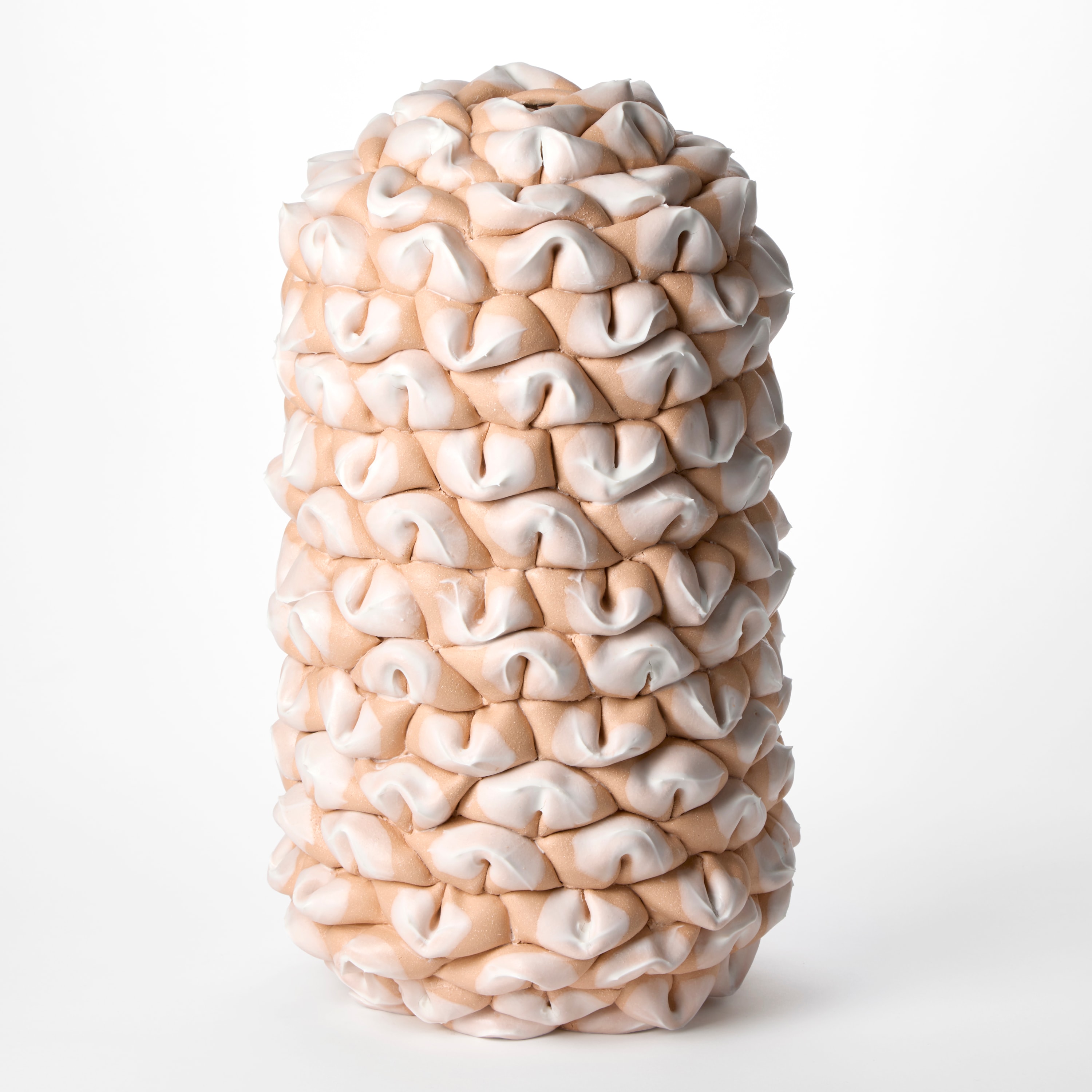
Dip Fold IV
Unique
H 49.5 cm W 28 cm D 28 cm
Stoneware & parian
“Stoneware and parian clay spheres are halved and folded together to build a repetitive layering of pinched surface shapes to create this column-like form. They are partially immersed in parian slip, achieving a smooth, satin-like coating. The speed and duration of each dip influences the thickness. Careful attention is given to the separation of surfaces, where the final touchpoint is manipulated to form a concentrated peak, capturing a suspended moment in time.”
![]()
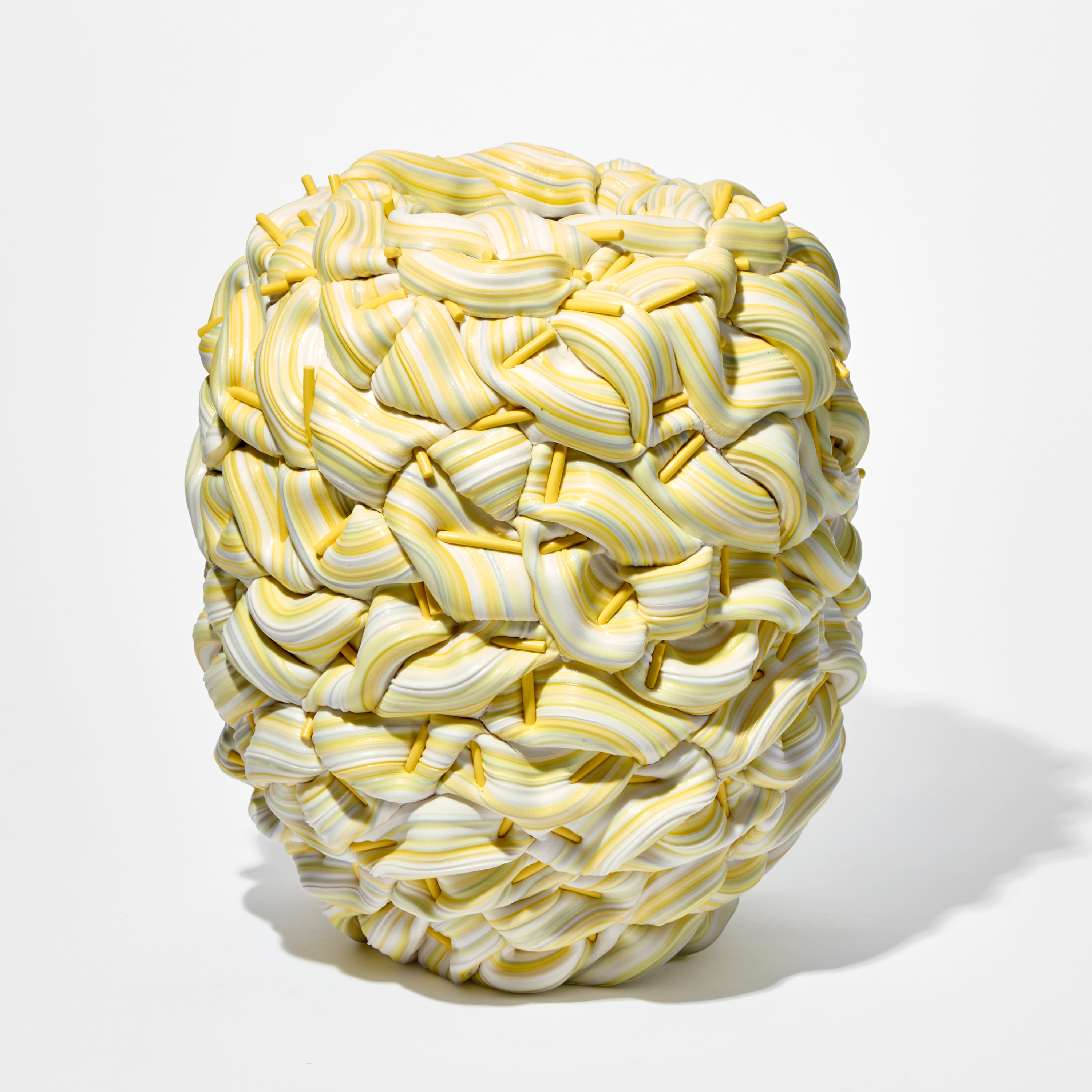
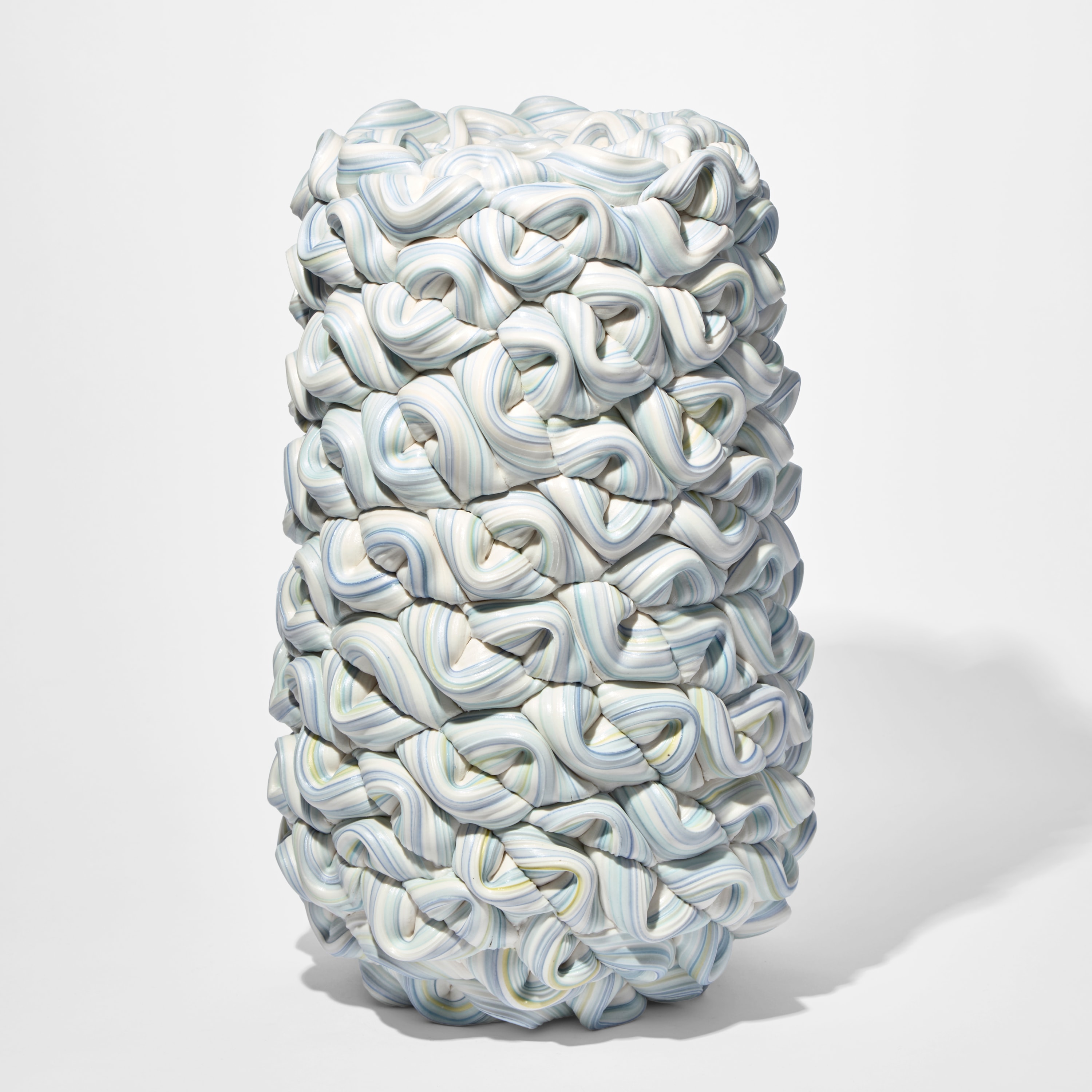
Striped Fold with Inclusions III
Unique
H 36 cm W 29 cm D 29 cm
Parian & porcelain
“Bright and bulbous, the form is wrapped with layers of ribbon like folds that are detailed with lines of colour. The surface weave is interrupted and influenced by short solid yellow rods. During the making, the folds take in and move around these added focal points.”
![]()
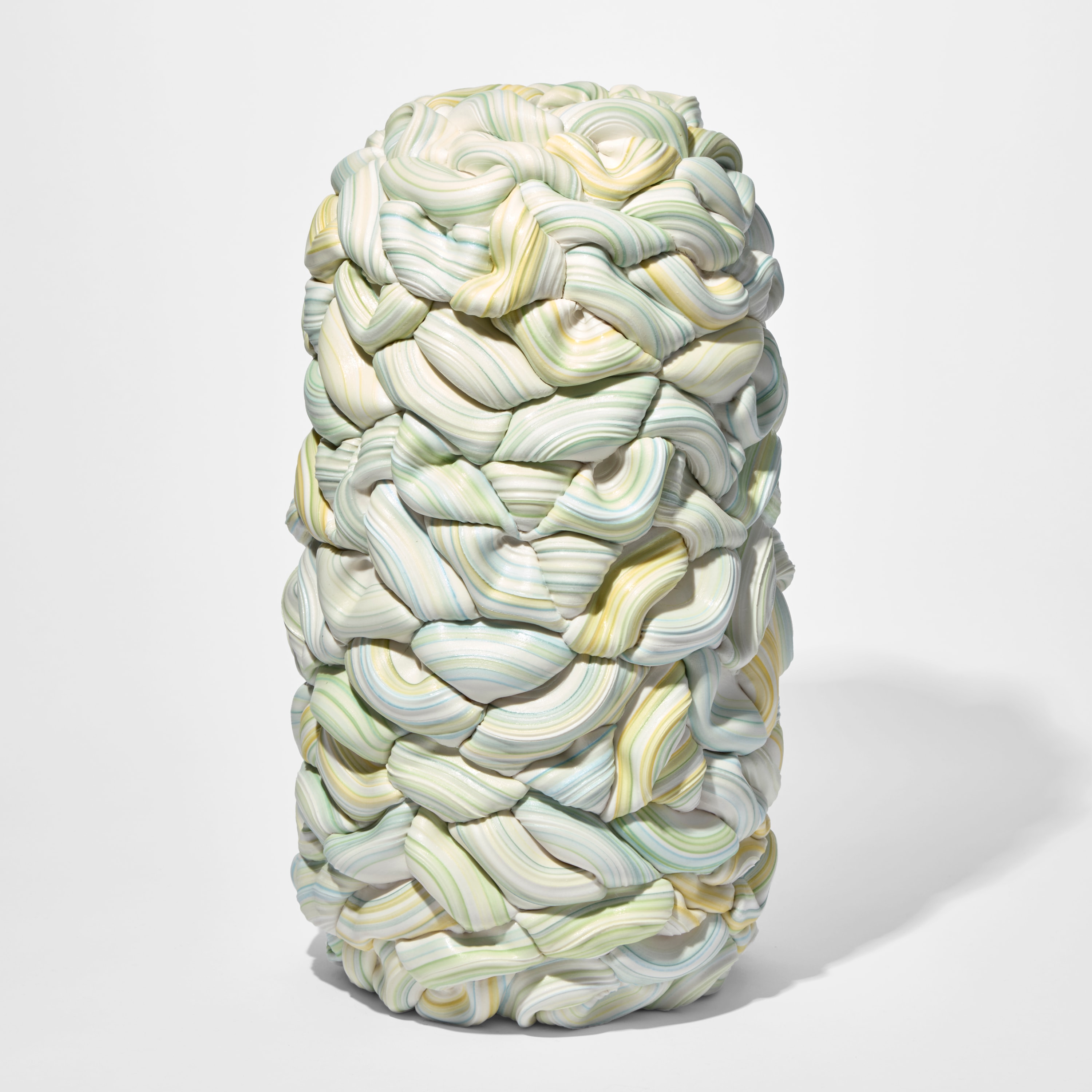
Striped Fold XXIV
Unique
H 47.5 cm W 24 cm D 24 cm
Parian & porcelain
"Layered with subtle linear tones of green, blue and yellow, each folded section is woven together, with the placement guided by responsive decision-making. I move between control and letting the creases, joins and attachments happen naturally. The overall form combines organic, soft transitions with rounded geometric shapes.”
![]()
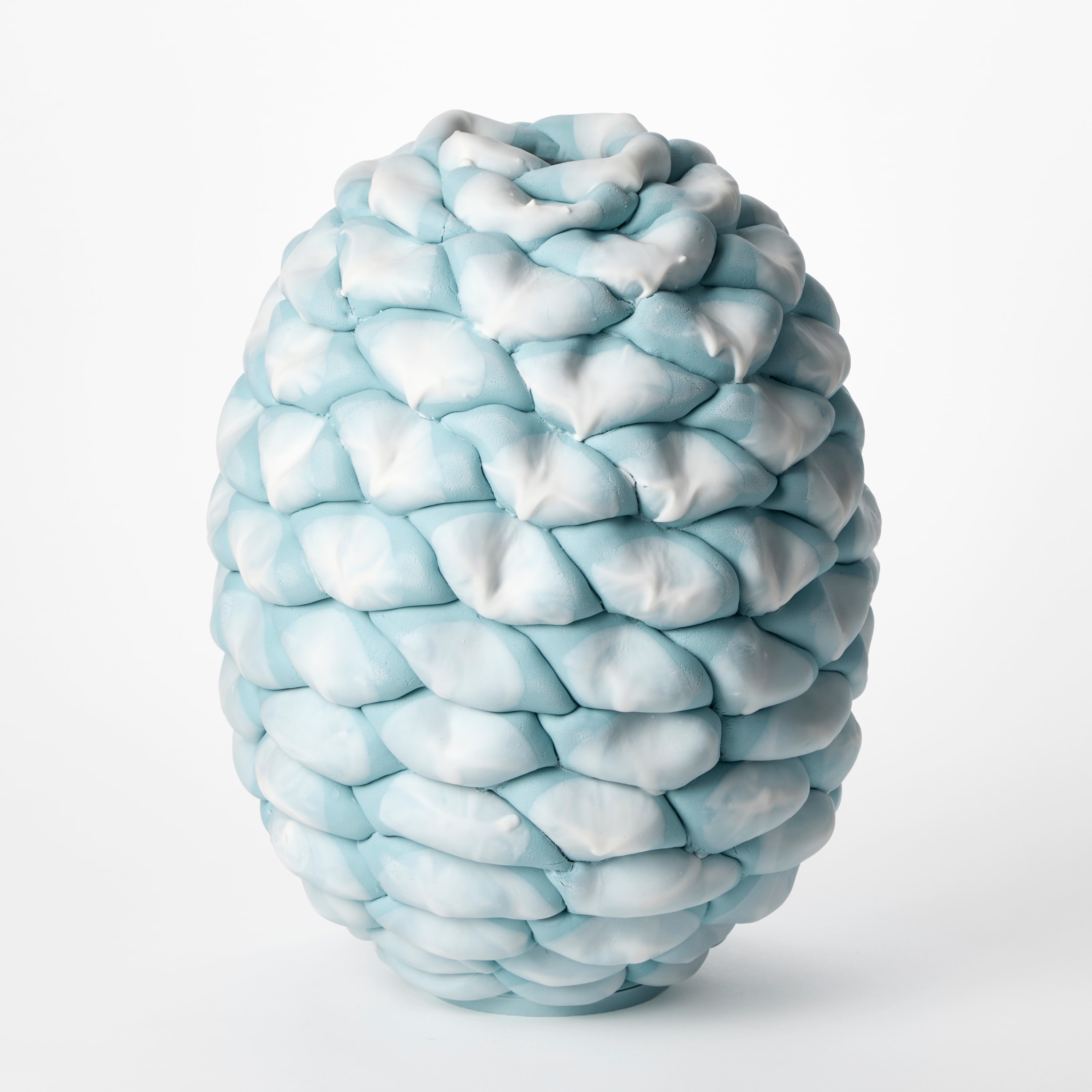
Dip Fold III
Unique
H 36 cm W 30 cm D 30 cm
Parian & porcelain
“Oval in profile, the form is created from parian clay spheres that are partially immersed in parian slip, achieving a smooth, satin-like coating. The speed and duration of each dip influences the thickness. Careful attention is given to the separation of surfaces, where the final touchpoint is manipulated to form a concentrated peak, capturing a suspended moment in time. The clay spheres are then cut, shaped and folded into the weave of the surface, enhancing the sense of depth and movement across the surface.”
![]()
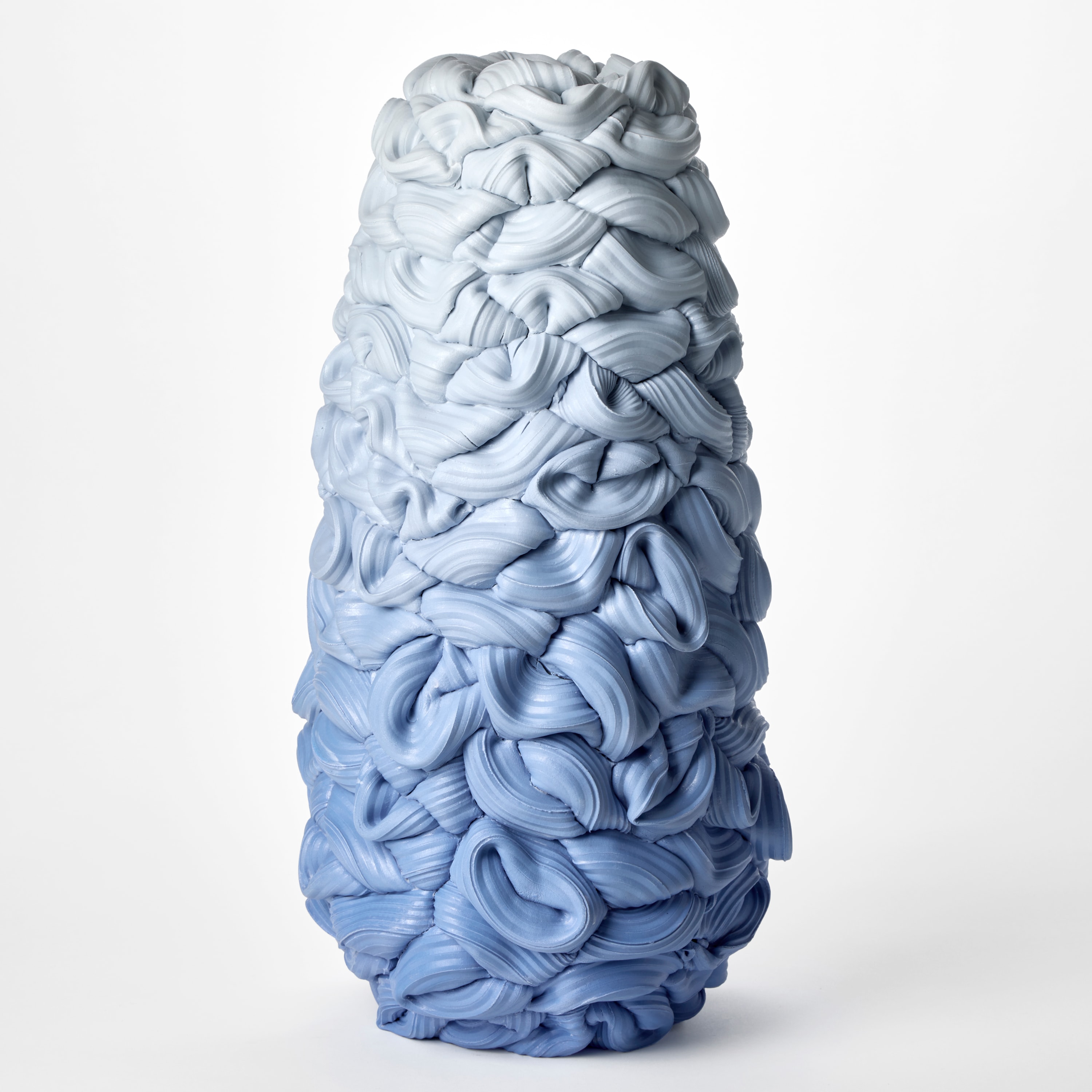
Monochromatic Fold XIV
Unique
H 53.5 cm W 26 cm D 26 cm
Parian & porcelain
“Featuring a gradation of blue, this tall elongated form begins with rich concentrated colour at the base. Each folded section is woven together, with the placement guided by responsive decision-making – switching from control to allowing the creases, joins and attachments to occur naturally. The overall shape is a mix of organic and soft transitions of balanced geometric shapes.”
![]()
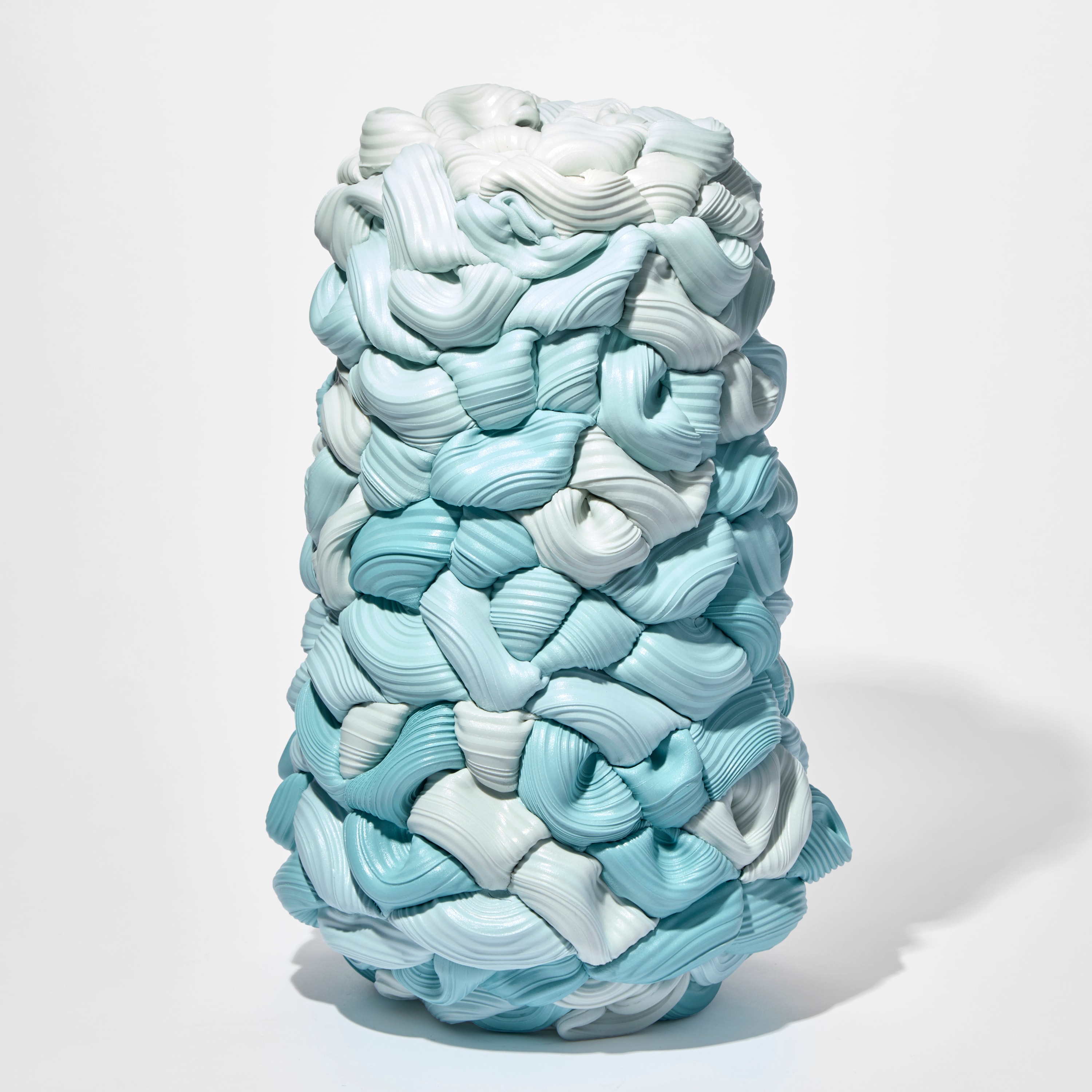
Monochromatic Fold XV
Unique
H 48 cm W 28 cm D 28 cm
Parian & porcelain
"A tonal patchwork of turquoise and white is present throughout this stacked form. Each folded section is woven together, with the placement guided by responsive decision-making. I move between control and letting the creases, joins and attachments happen naturally. The overall form combines organic, soft transitions with rounded geometric shapes.”
![]()
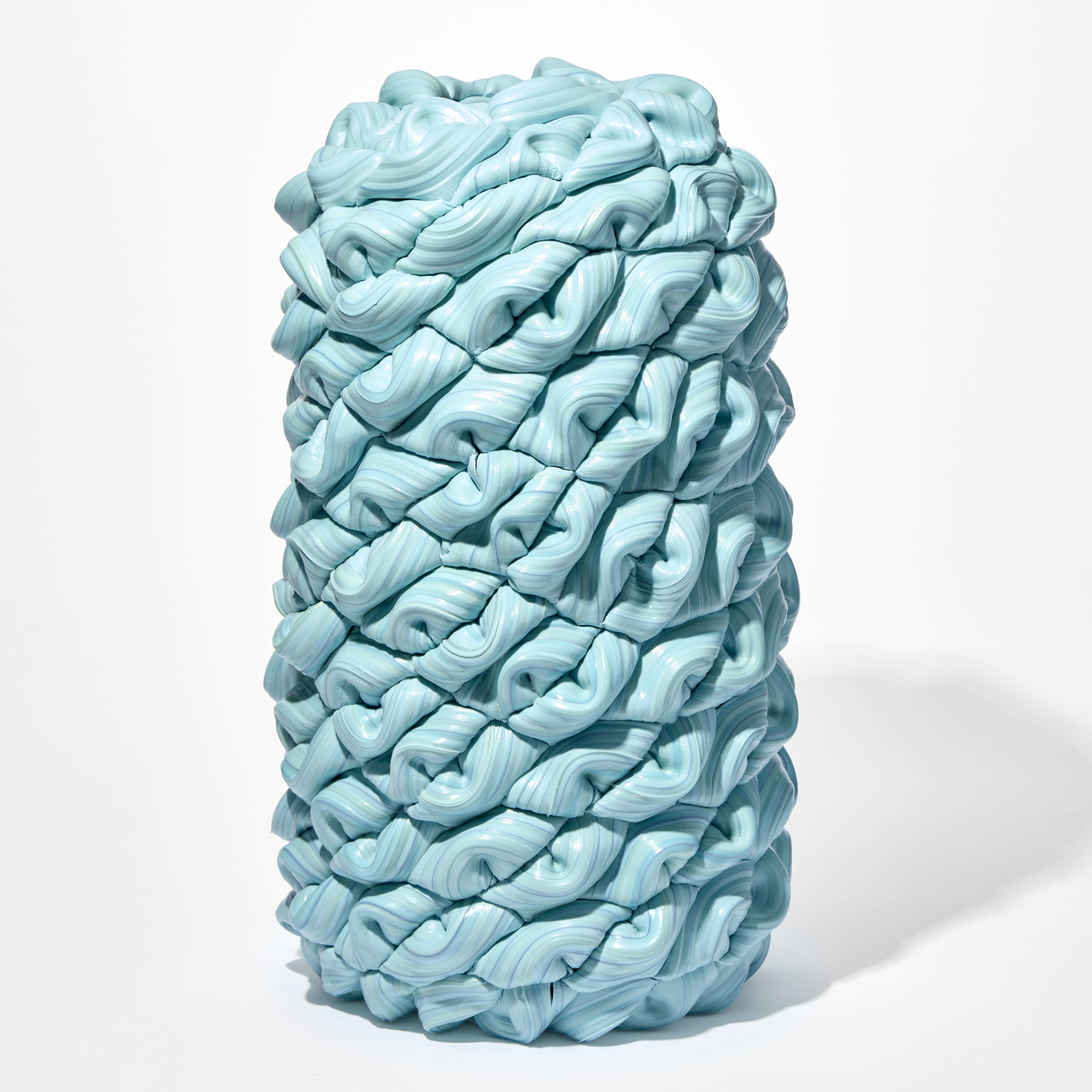
Striped Fold XXVI
Unique
H 49 cm W 26 cm D 26 cm
Parian & porcelain
"Parian and porcelain clay spheres are halved and folded together to build a repetitive layering of pinched surface shapes. Each segment is detailed with a profile of lines that weave in a diagonal grid, in and around the surface like the wrapping of textile or layering loops of rope. The surface is finished with satin sheen created from a wash of glaze during the final firing.”
![]()
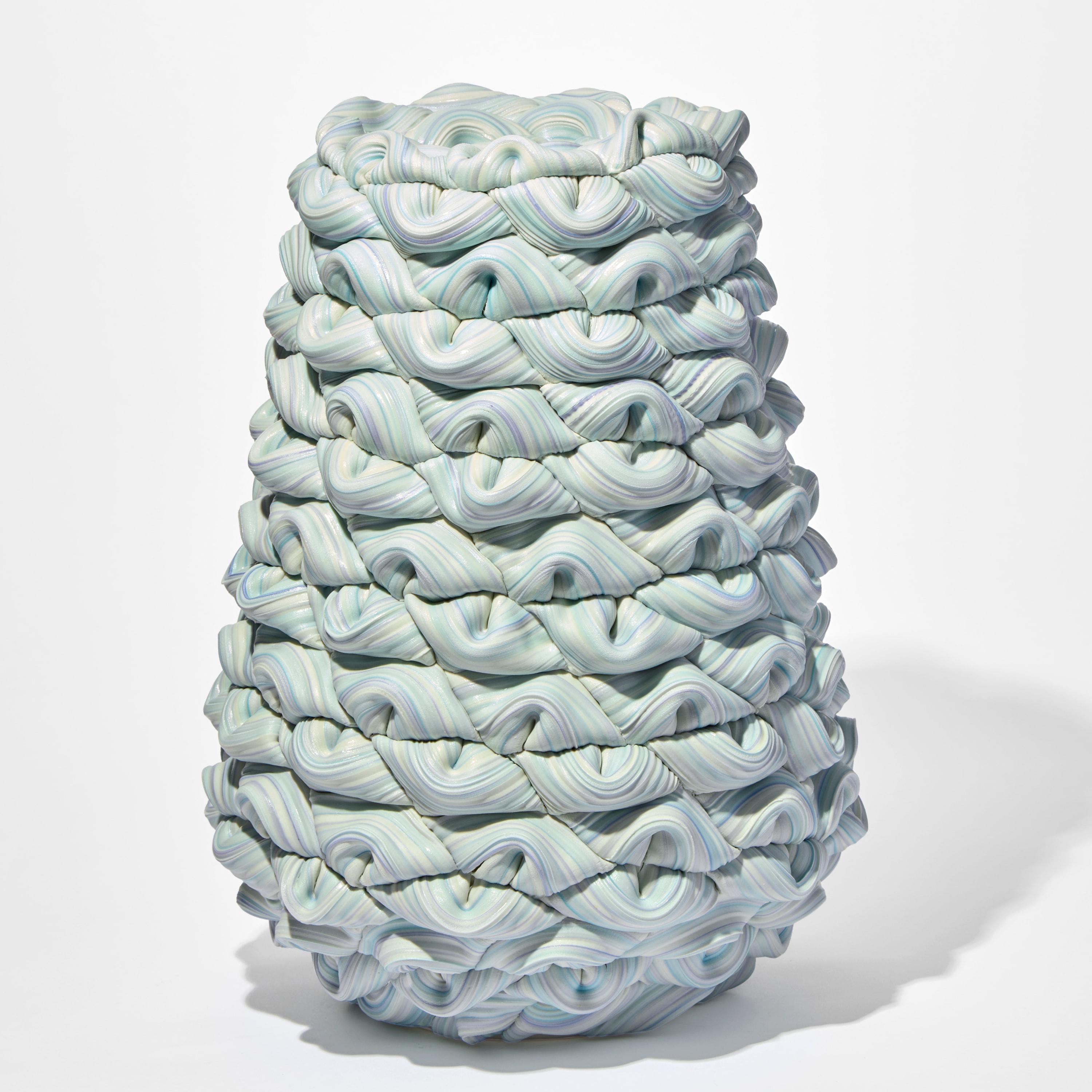
Striped Fold XXVIII
Unique
H 46.5 cm W 31 cm D 31 cm
Parian & porcelain
“Flaring at the base, this generous form is created from parian and porcelain clay spheres that are halved and folded together to build a repetitive layering of pinched surface shapes. Each segment is detailed with a profile of lines that weave in and around the surface like the wrapping of textile or layering loops of rope. The surface is finished with satin sheen created from a wash of glaze during the final firing.”
![]()
Striped Fold XXV
Unique
H 49 cm W 29 cm D 29 cm
Parian & porcelain
“Striped spheres thrown in parian and porcelain are halved and folded together to build a repetitive layering of pinched surface shapes to create this generous form. Each segment is detailed with a profile of lines that weave in and around the surface like the wrapping of textile or layering loops of rope. The surface is finished with satin sheen created from a wash of glaze during the final firing.”
![]()
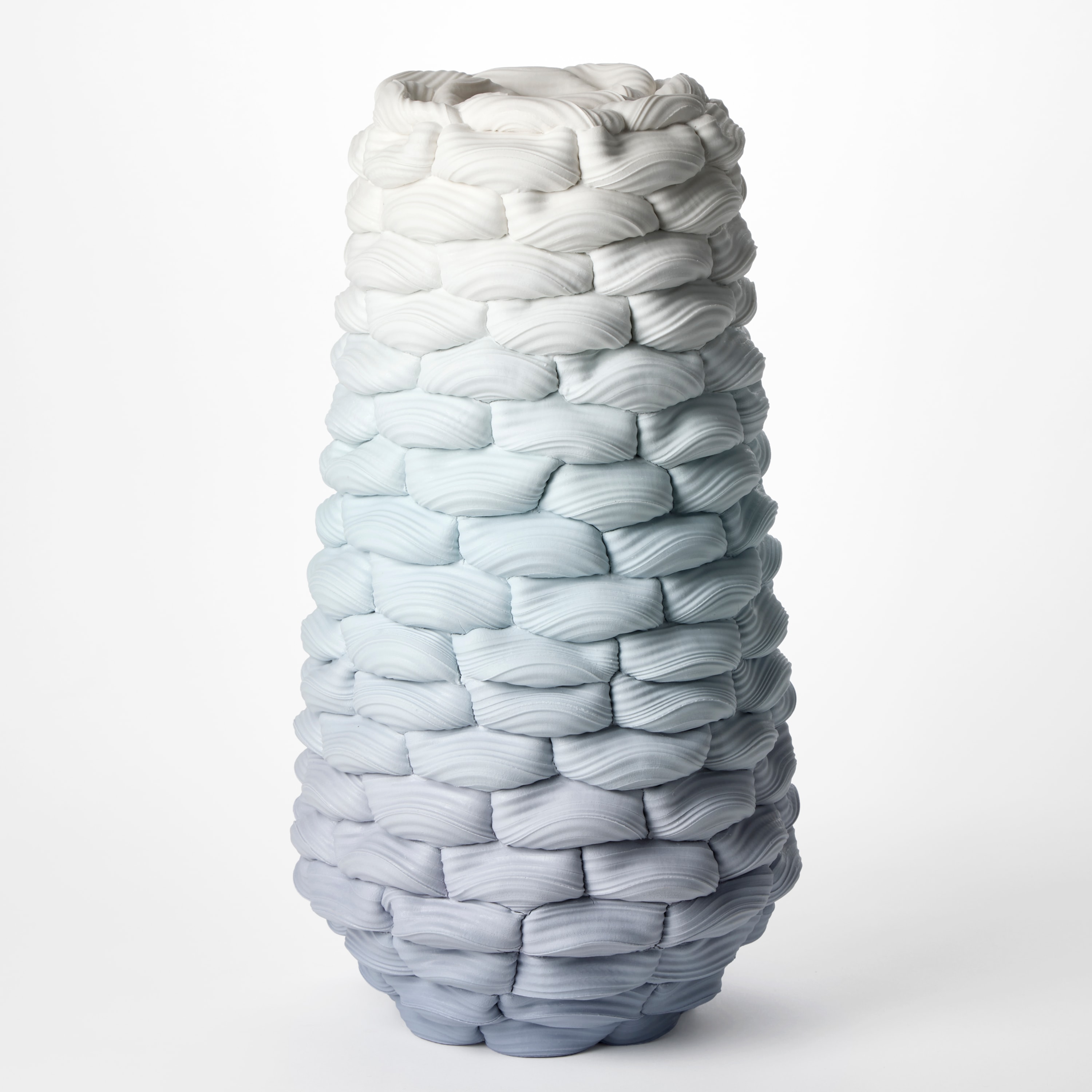
Analogous Fold II
Unique
H 51 cm W 26 cm D 26 cm
Parian & porcelain
“A blended gradation of purple, blue to white, rises up through this tall elongated form. Each layer is built on a grid of hollow cushioned folds that appear to relax into place like a wall of inflated segments. It’s puffy appearance has a satin sheen surface created from a wash of glaze during the final firing."
![]()
View Exhibition
About the artist
Steven Edwards is a ceramic artist whose work investigates the language of making through the materiality and physicality of clay. He uses traditional techniques that provoke unanticipated outcomes, using clay as a medium that sustains the narrative of the making process. The resulting forms embody his interaction and manipulation of the clay using bespoke tools to explore the intrinsic properties of the material.
Whilst challenging and pushing his material to the limits, often using clay bodies in ways they are not designed for, Edwards purposely exploits unexpected results. Creating a sense of unease, during the making his clay cracks and buckles, resulting in permanent scars that illustrate the extremes that have been asked of it. Purely aesthetic, these fissures within the surface are an important counter point to the idealised, often confectionery sugary-hued, layered rings.
Edwards has exhibited his work at premiere contemporary design and craft shows including the British Ceramics Biennial, London Craft Week, London Design Festival and Paris Design Week, as well as extensively in the UK and Europe. He has also made large-scale outdoor installations, including From Humble Beginnings as part of the Surrey Unearthed Arts Council funded project at the Watts Gallery. He has work within the permanent collections of Chatsworth House, home of the Devonshire family. In 2024 Edwards was a finalist for the Brookfield Properties Craft Award during Collect, the Craft Council’s Art Fair in London.
Artwork photography by Agata Pec | www.agatapec.com
All other photography courtesy of the artist, except for the Brookfield award portrait, which is courtesy of Maia Blunt & the Crafts Council.
With his forthcoming 2nd solo exhibition Soft Geometry at Vessel Gallery beginning on the 5th May - and continuing to coincide with London Craft Week - we ask Steven Edwards to give us some insight into his new works and his practice.
What can you tell us about your new show?
“This new body of work builds on my interest in process-led art, where each piece develops through intuitive actions and experimenting with materials. The making involves cutting, rearranging, layering and reworking things as I go. Each piece becomes a record of how it was made – showing the choices, changes and interruptions along the way. Ultimately, the work grows out of curiosity and wonder, shaped by an eclectic mix of influences spanning art, craft, design, geology, architecture and theory.”
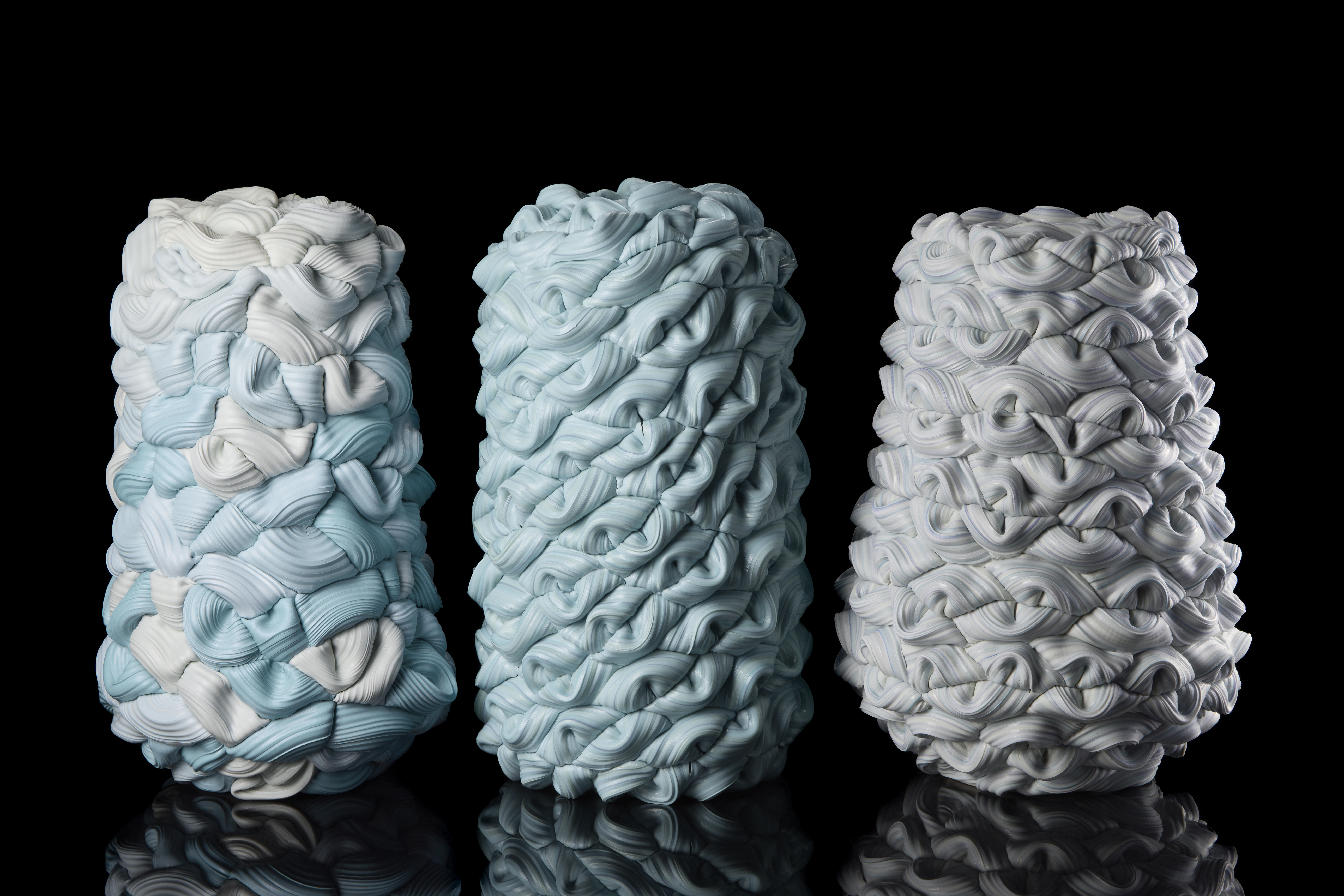
New unique works on show for Soft Geometry
How did you get started in ceramics and what ‘drew’ you to the material?
“I have been working with clay for approximately 30 years, initially being introduced to it during a life drawing art class at school where we sculpted with clay, then specialising as a medium whilst studying art and design at college. What resonated most with me was the clay’s immediacy and how it captures the process of making, allowing my interaction with it to be visibly recorded.”
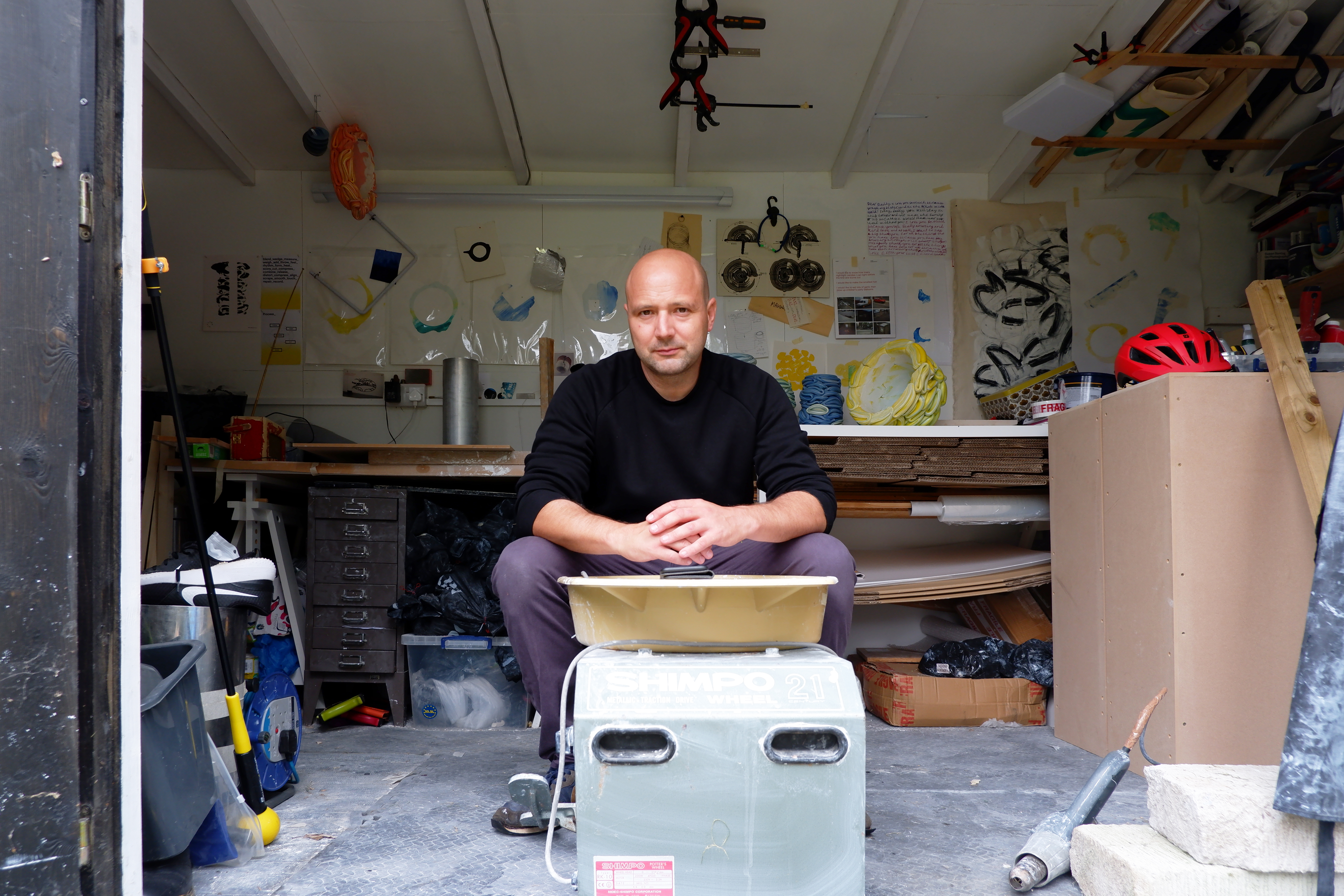
Steven Edwards in his studio
There is a gap between studying for your BA in applied arts and your MA in ceramics, what were you doing in-between and has that time helped what you do now?
“After completing my degree, I chose to pursue a career in design. I spent the next 18 years working as a graphic designer while continuing to make ceramic work in my spare time. In 2018, I completed a Masters degree in Ceramics, which marked a turning point in my practice. From then on, I began focusing more fully on developing my ceramic portfolio and transitioning towards a career as a full-time artist.
My background in graphic design has strongly shaped the way I develop and realise my work. It has trained me to think critically about composition, balance and visual hierarchy, and to consider how language, form, grids and colour, can drive meaning. These influences support the way I generate ideas and maintain a process-led approach to making, where the forms I create communicate through malleable woven shapes and a bold, graphic use of colour.”
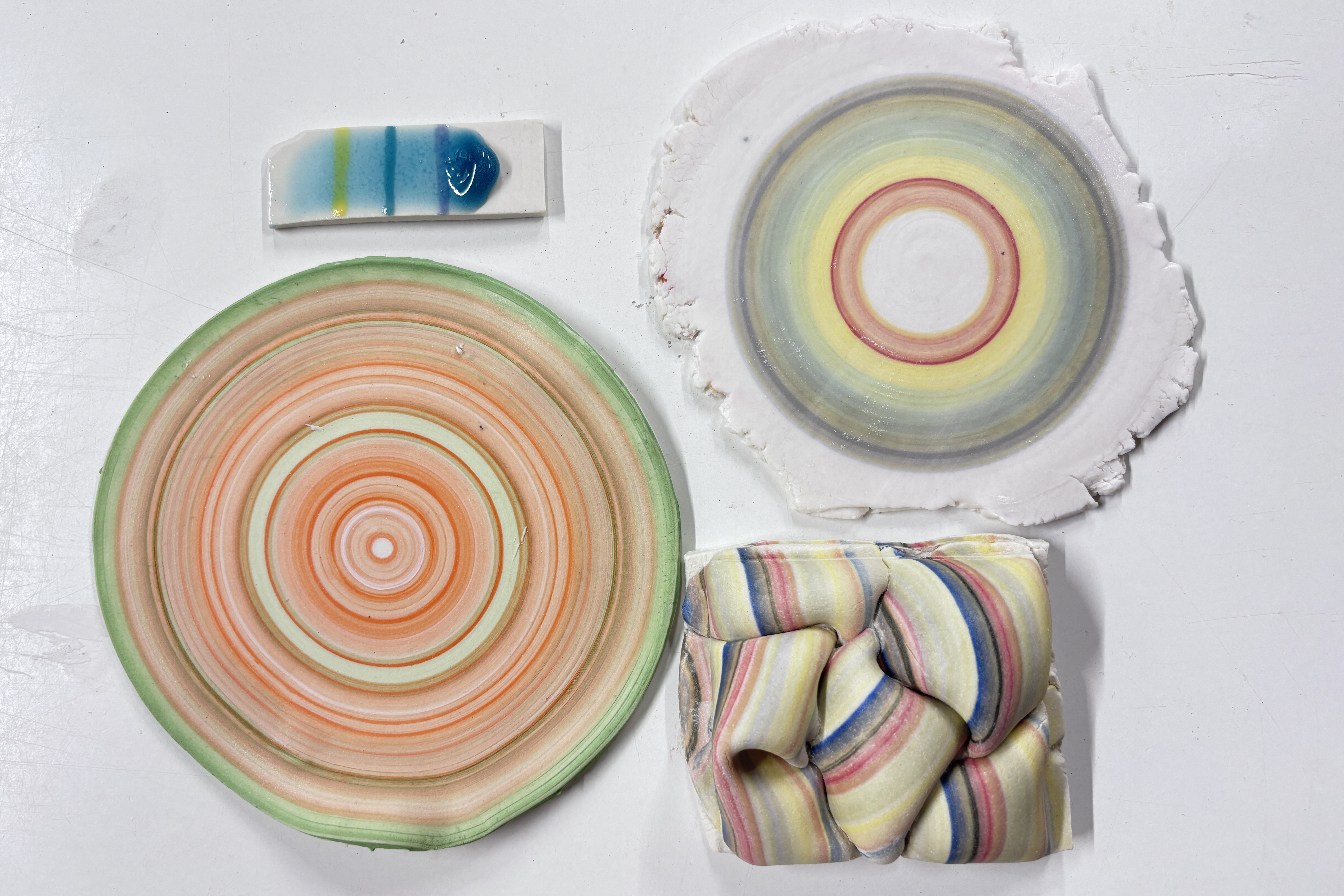
Graphic linear colour blend tests
What do you find to be the most challenging aspect of your practice?
“Reining in ideas and maintaining a clear, linear development in my work, alongside managing the technical demands of clay, remains a constant challenge.
I’ve found that sketching out distractions is an effective way to catalogue ideas; drawing allows many issues to be resolved early, helping to simplify the process. Still, there is always a necessary stage of trial and error in the making itself, a phase that brings me back on track.
Throughout the evolution of my practice, I’ve continually wrestled with the technical complexities of working with clay. These challenges are fundamental to the material. They must be embraced, as they build resilience and ultimately guide the work into new and unexpected directions.”
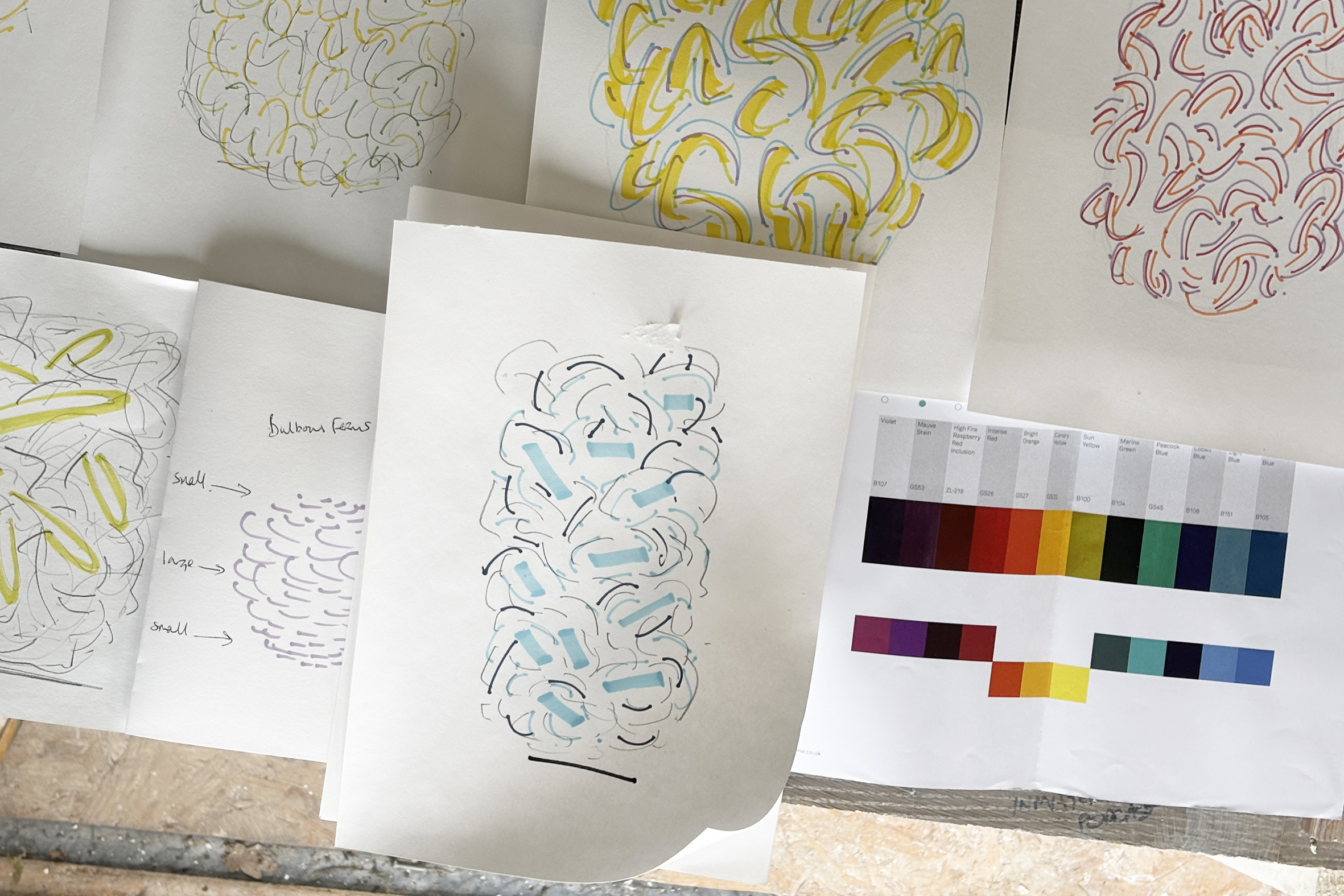
Working out ideas on paper
To date, what has been your ‘ceramics career’ high?
“The opportunities I’ve had through working with Vessel gallery have been incredibly meaningful. From my initial showcase, Infinite Folds, to exhibitions such as Artefact, The Value in Things and Collect – where I was a finalist for the Brookfield Craft Award – the experience and exposure have been gratefully received.”
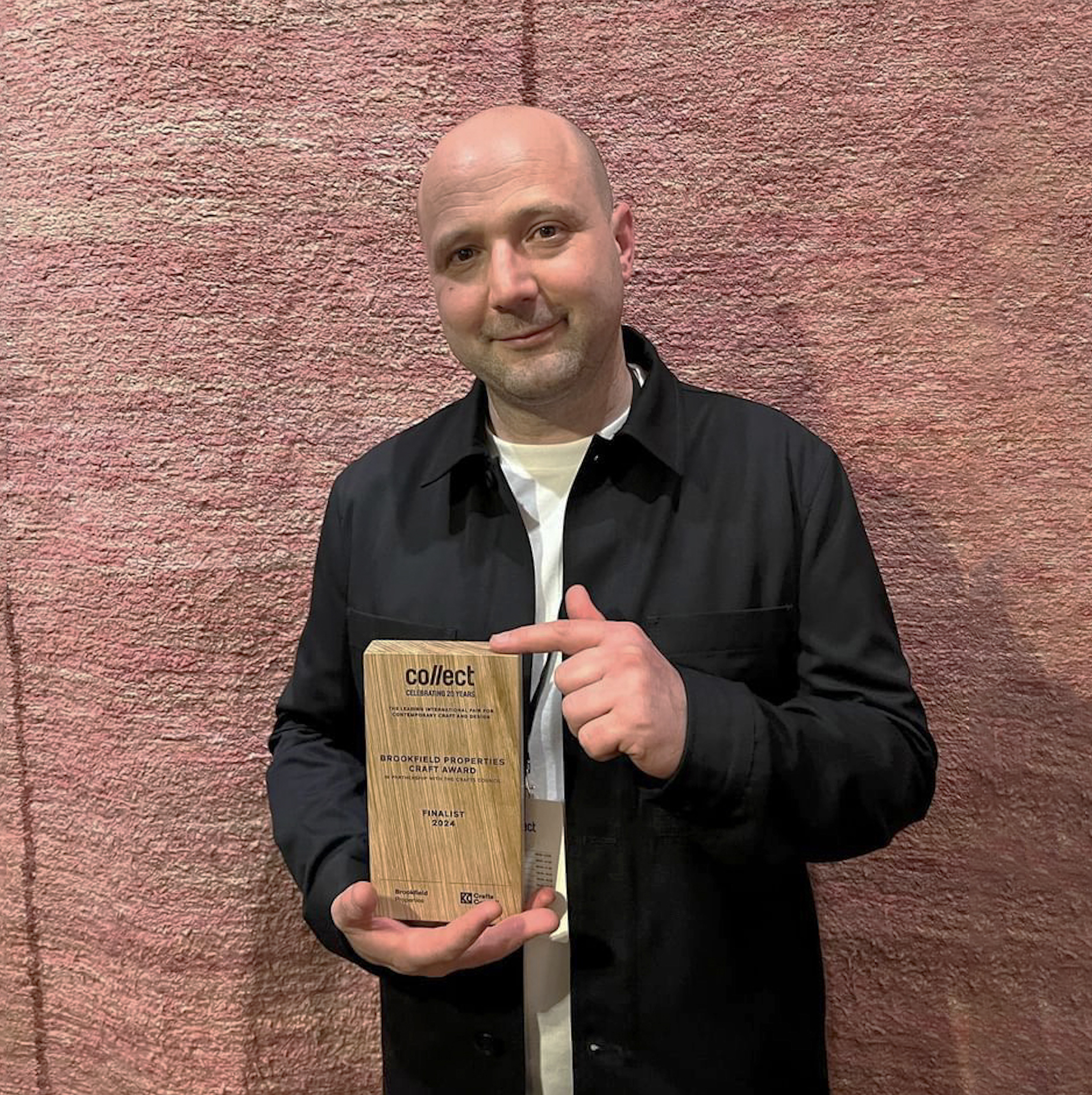
Brookfield Properties Craft Award finalist during Collect 2024, the Craft Council’s Art Fair in London
How do you feel about the state of British ceramics today?
“British ceramics feels vibrant at the moment. There’s a wave of interest in all the different ways people are using clay and you can see it everywhere – from long‑running events like the British Ceramics Biennial to newer shows that mix historical narratives and contemporary aesthetics. It’s inspiring to see British artists reimagining ceramic forms and continuing to challenge conventions.
I have a particular interest in how clay is used as a vehicle of expression in contemporary art. Putting aside the broader dialogue between art and craft, the work that really stands out tends to come from artists who understand the material, both technically and historically, while still making something that feels relevant today.
At the university where I work, there’s been a noticeable rise in students wanting to explore ceramics across all sorts of disciplines. It reflects a bigger cultural shift toward valuing craft and the tactile, especially as so much of daily life has become digital. As ceramic spaces and courses get smaller and more integrated with other subjects, it’s encouraging to see organisations recognising how important ceramics can be in education - not just for understanding history and culture but for the sensory and creative benefits it offers. How this compression of the subject is adapted over the coming years remains a concern.”
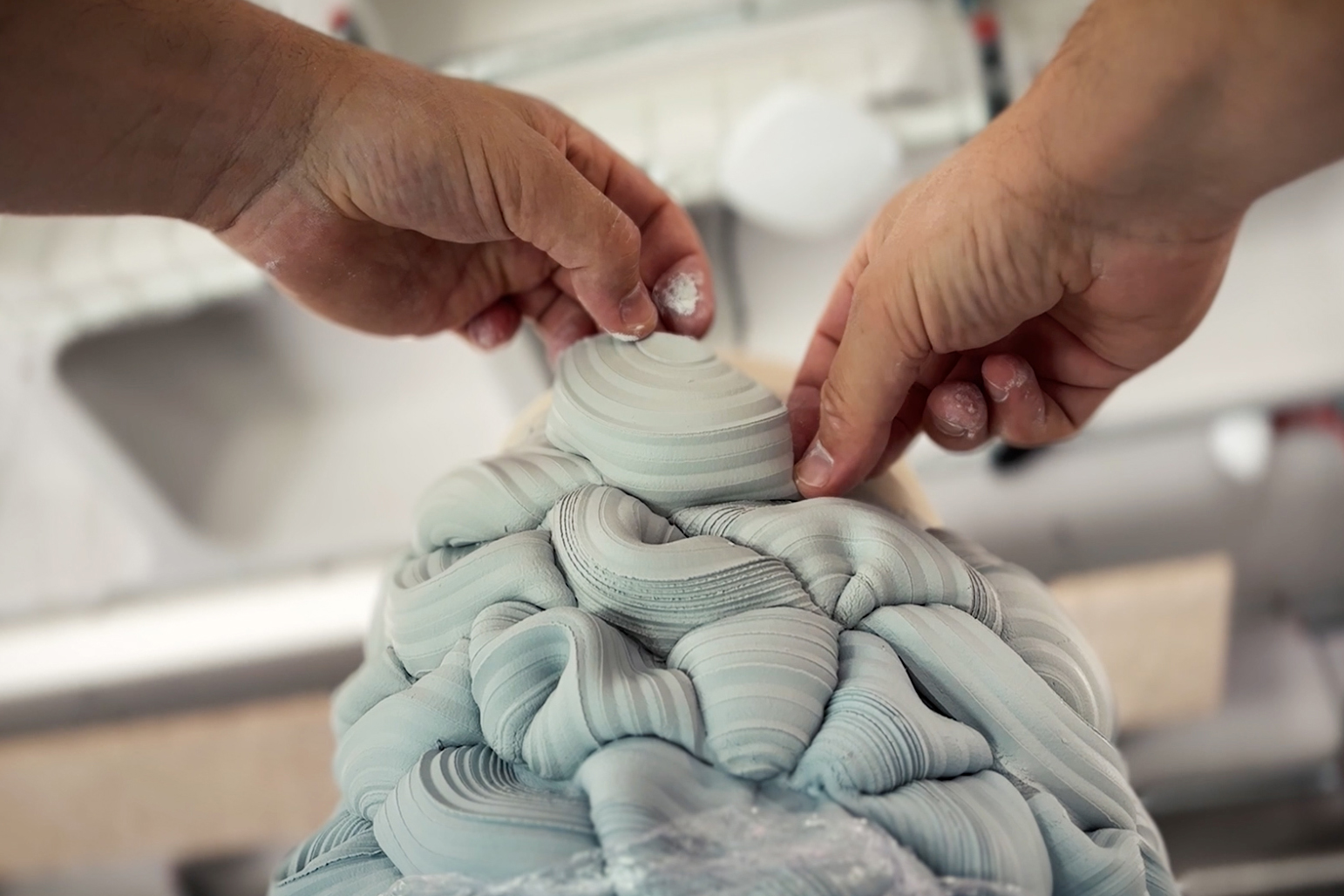
Edwards in action, using his unique methods of making
Which living ceramic artist do you most admire and why?
“A key influence is Japanese ceramicist Yo Akiyama, who is known for exposing geological qualities in clay. The scale, technique and method of making in his work is something I really admire. He was a leading figure of Sodeisha, an avant-garde ceramicist group that reimagined ceramics as nonfunctional sculptural practice. He has a major sculptural work at the V&A Museum – Geological Age V – which I always make a point to visit whenever I’m there.”
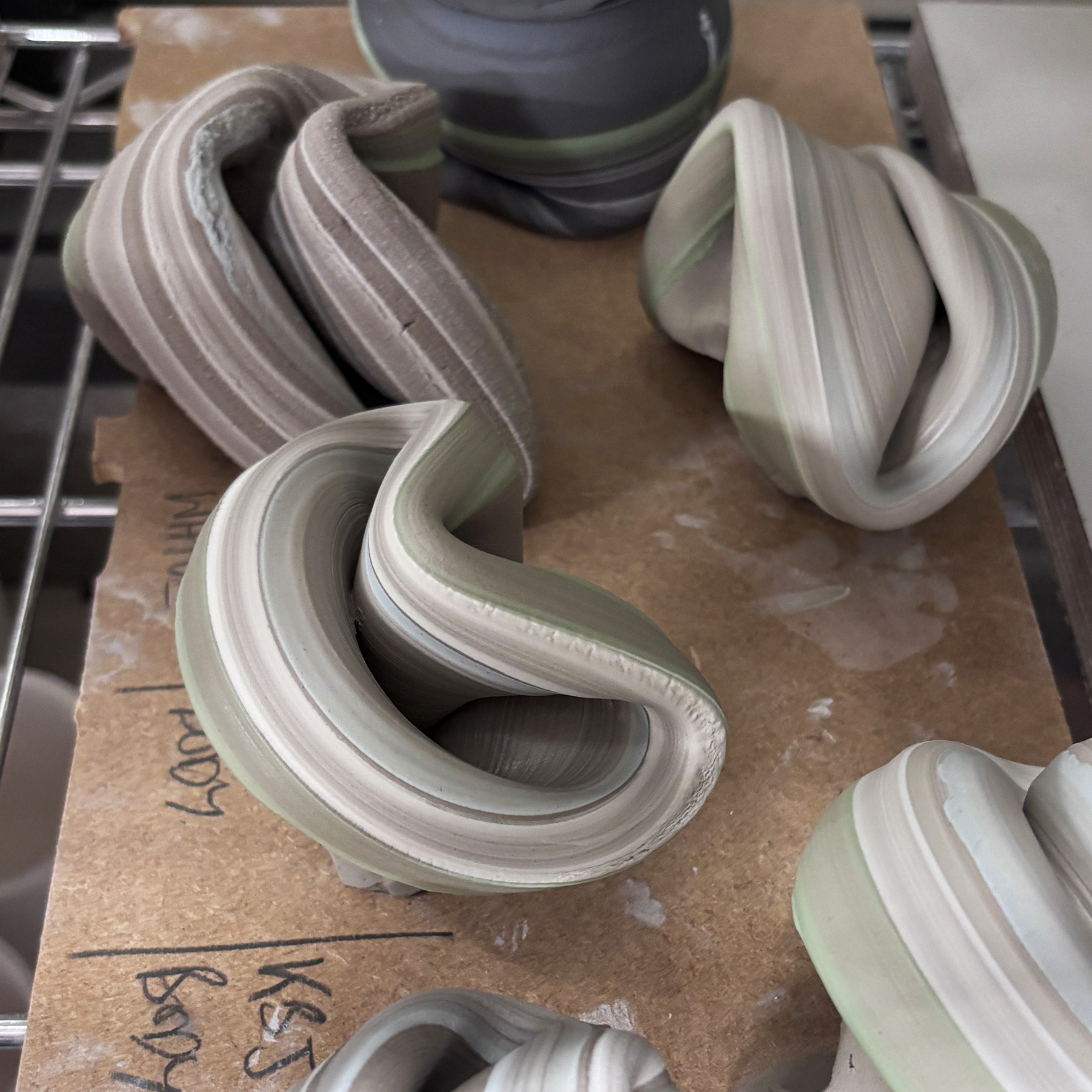
Line fold tests, hinting at the influence of Akiyama Yo on Edwards' practice
If you could collaborate with any artist, from any background, who would that be and why?
“Daniel Eatock blurs the boundaries between art and design through wit, innovation and a rigorous approach to developing ideas. His work often appears deceptively simple, yet reveals an underlying complexity shaped by questioning, refinement and problem-solving. I would be interested to see how he might approach a collaborative project using clay. His art and design background could offer a fresh way of generating ideas and proposals through the medium, free from preconceptions around constraints or material limitations, those challenges could be explored and resolved through the process.”
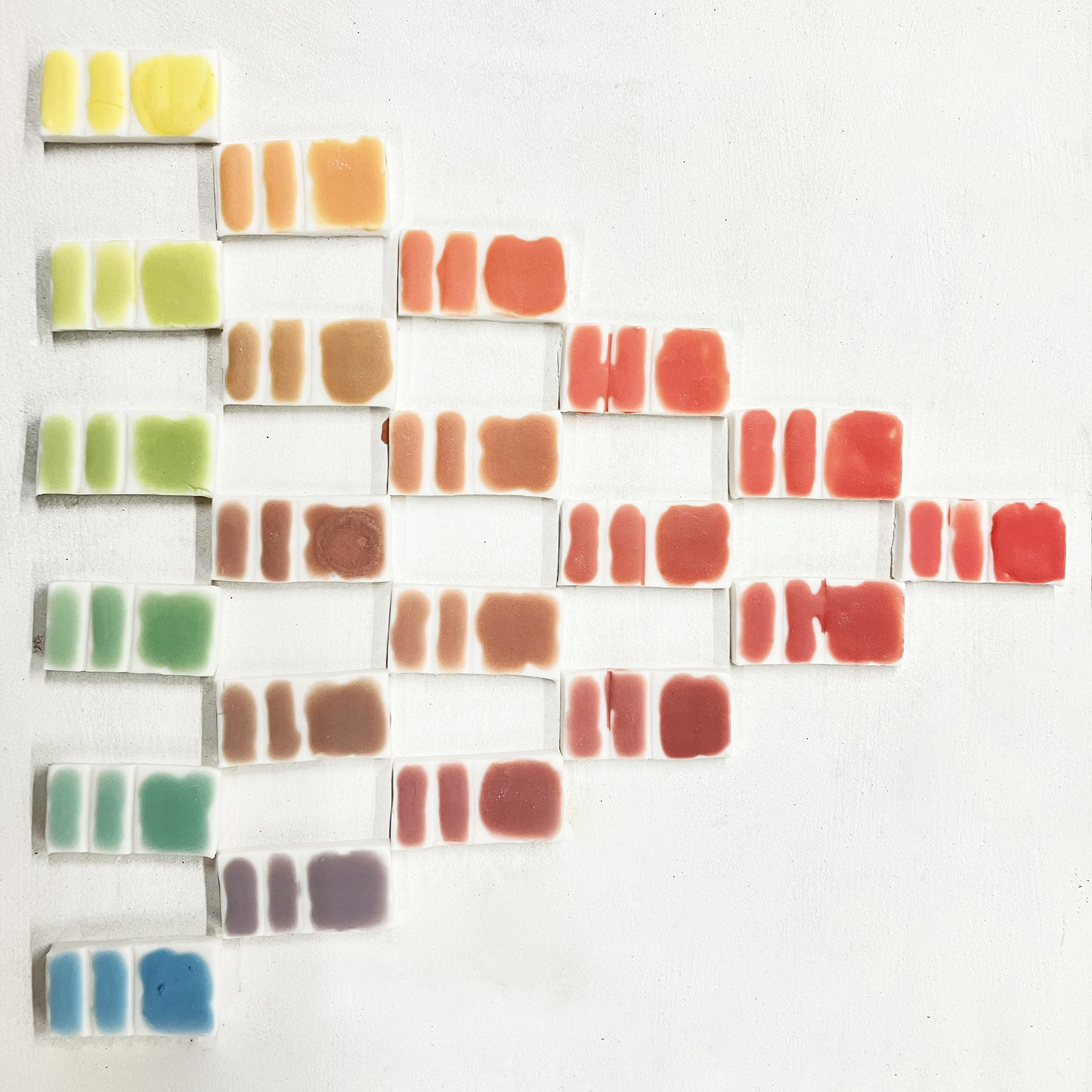
Triaxial colour blend tests by Edwards
Can you share any future plans? Either ones set in stone or something you would love to make happen?
“My ambition is to create work on a larger scale and to explore alternative firing techniques. I see this as a gradual evolution in my practice, ultimately leading to the ability to build and manage my own large-scale firings at my studio. In the meantime, I’m seeking opportunities for a residency or workshop, either in the UK or abroad, that can support large-scale making and firing processes.
I’m also looking at ways to broaden my process-led workshops where people are encouraged to explore the language of making through a playful experimentation of process. I have created a catalogue of ideas, including experience from workshops in the past with educational and corporate groups. I have found the collaboration of ideas to be an important extension of my practice.”
Soft Geometry - Exhibition artworks with explanations by the artist
5th May - 5th June 2026
Dip Fold IV
Unique
H 49.5 cm W 28 cm D 28 cm
Stoneware & parian
“Stoneware and parian clay spheres are halved and folded together to build a repetitive layering of pinched surface shapes to create this column-like form. They are partially immersed in parian slip, achieving a smooth, satin-like coating. The speed and duration of each dip influences the thickness. Careful attention is given to the separation of surfaces, where the final touchpoint is manipulated to form a concentrated peak, capturing a suspended moment in time.”
Striped Fold with Inclusions III
Unique
H 36 cm W 29 cm D 29 cm
Parian & porcelain
“Bright and bulbous, the form is wrapped with layers of ribbon like folds that are detailed with lines of colour. The surface weave is interrupted and influenced by short solid yellow rods. During the making, the folds take in and move around these added focal points.”
Striped Fold XXIV
Unique
H 47.5 cm W 24 cm D 24 cm
Parian & porcelain
"Layered with subtle linear tones of green, blue and yellow, each folded section is woven together, with the placement guided by responsive decision-making. I move between control and letting the creases, joins and attachments happen naturally. The overall form combines organic, soft transitions with rounded geometric shapes.”
Dip Fold III
Unique
H 36 cm W 30 cm D 30 cm
Parian & porcelain
“Oval in profile, the form is created from parian clay spheres that are partially immersed in parian slip, achieving a smooth, satin-like coating. The speed and duration of each dip influences the thickness. Careful attention is given to the separation of surfaces, where the final touchpoint is manipulated to form a concentrated peak, capturing a suspended moment in time. The clay spheres are then cut, shaped and folded into the weave of the surface, enhancing the sense of depth and movement across the surface.”
Monochromatic Fold XIV
Unique
H 53.5 cm W 26 cm D 26 cm
Parian & porcelain
“Featuring a gradation of blue, this tall elongated form begins with rich concentrated colour at the base. Each folded section is woven together, with the placement guided by responsive decision-making – switching from control to allowing the creases, joins and attachments to occur naturally. The overall shape is a mix of organic and soft transitions of balanced geometric shapes.”
Monochromatic Fold XV
Unique
H 48 cm W 28 cm D 28 cm
Parian & porcelain
"A tonal patchwork of turquoise and white is present throughout this stacked form. Each folded section is woven together, with the placement guided by responsive decision-making. I move between control and letting the creases, joins and attachments happen naturally. The overall form combines organic, soft transitions with rounded geometric shapes.”
Striped Fold XXVI
Unique
H 49 cm W 26 cm D 26 cm
Parian & porcelain
"Parian and porcelain clay spheres are halved and folded together to build a repetitive layering of pinched surface shapes. Each segment is detailed with a profile of lines that weave in a diagonal grid, in and around the surface like the wrapping of textile or layering loops of rope. The surface is finished with satin sheen created from a wash of glaze during the final firing.”
Striped Fold XXVIII
Unique
H 46.5 cm W 31 cm D 31 cm
Parian & porcelain
“Flaring at the base, this generous form is created from parian and porcelain clay spheres that are halved and folded together to build a repetitive layering of pinched surface shapes. Each segment is detailed with a profile of lines that weave in and around the surface like the wrapping of textile or layering loops of rope. The surface is finished with satin sheen created from a wash of glaze during the final firing.”
Striped Fold XXV
Unique
H 49 cm W 29 cm D 29 cm
Parian & porcelain
“Striped spheres thrown in parian and porcelain are halved and folded together to build a repetitive layering of pinched surface shapes to create this generous form. Each segment is detailed with a profile of lines that weave in and around the surface like the wrapping of textile or layering loops of rope. The surface is finished with satin sheen created from a wash of glaze during the final firing.”
Analogous Fold II
Unique
H 51 cm W 26 cm D 26 cm
Parian & porcelain
“A blended gradation of purple, blue to white, rises up through this tall elongated form. Each layer is built on a grid of hollow cushioned folds that appear to relax into place like a wall of inflated segments. It’s puffy appearance has a satin sheen surface created from a wash of glaze during the final firing."
View Exhibition
About the artist
Steven Edwards is a ceramic artist whose work investigates the language of making through the materiality and physicality of clay. He uses traditional techniques that provoke unanticipated outcomes, using clay as a medium that sustains the narrative of the making process. The resulting forms embody his interaction and manipulation of the clay using bespoke tools to explore the intrinsic properties of the material.
Whilst challenging and pushing his material to the limits, often using clay bodies in ways they are not designed for, Edwards purposely exploits unexpected results. Creating a sense of unease, during the making his clay cracks and buckles, resulting in permanent scars that illustrate the extremes that have been asked of it. Purely aesthetic, these fissures within the surface are an important counter point to the idealised, often confectionery sugary-hued, layered rings.
Edwards has exhibited his work at premiere contemporary design and craft shows including the British Ceramics Biennial, London Craft Week, London Design Festival and Paris Design Week, as well as extensively in the UK and Europe. He has also made large-scale outdoor installations, including From Humble Beginnings as part of the Surrey Unearthed Arts Council funded project at the Watts Gallery. He has work within the permanent collections of Chatsworth House, home of the Devonshire family. In 2024 Edwards was a finalist for the Brookfield Properties Craft Award during Collect, the Craft Council’s Art Fair in London.
Artwork photography by Agata Pec | www.agatapec.com
All other photography courtesy of the artist, except for the Brookfield award portrait, which is courtesy of Maia Blunt & the Crafts Council.