Introduction and discussion with Helen Restorick
12th December 2025

Introduction and discussion with Helen Restorick
Having initially studied medicine and genetics, Helen Restorick moved her attention away from science to art, culminating in her studying for her MA in glass at the University for the Creative Arts, Farnham, in 2023. Often perceived as vastly differing, the scientific and the artistic are firmly connected, with examples to be found both historically, as well as in a more contemporary light. Therefore, this change in direction is not so unusual as it first might seem.
![]()
Helen Restorick, image courtesy of the artist
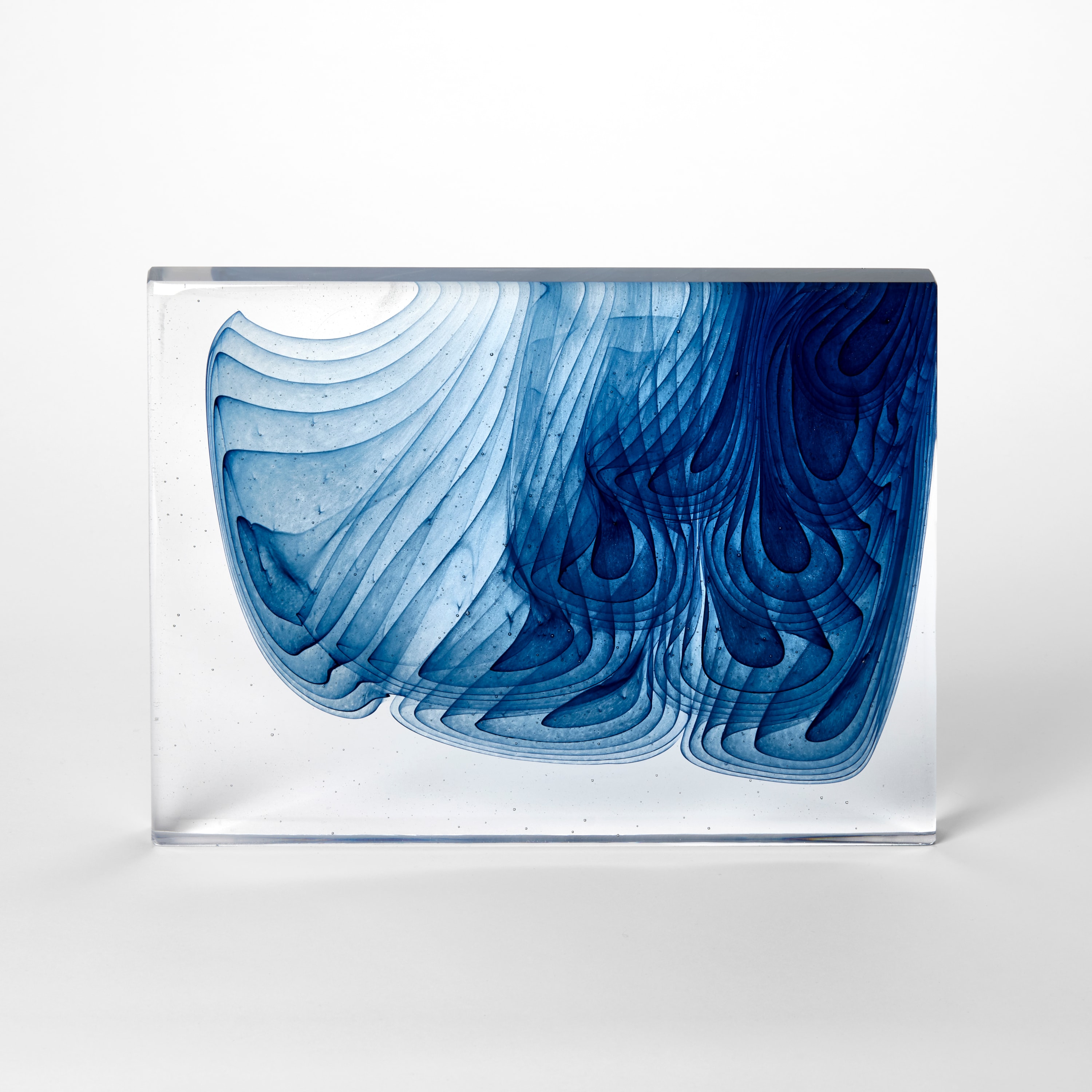
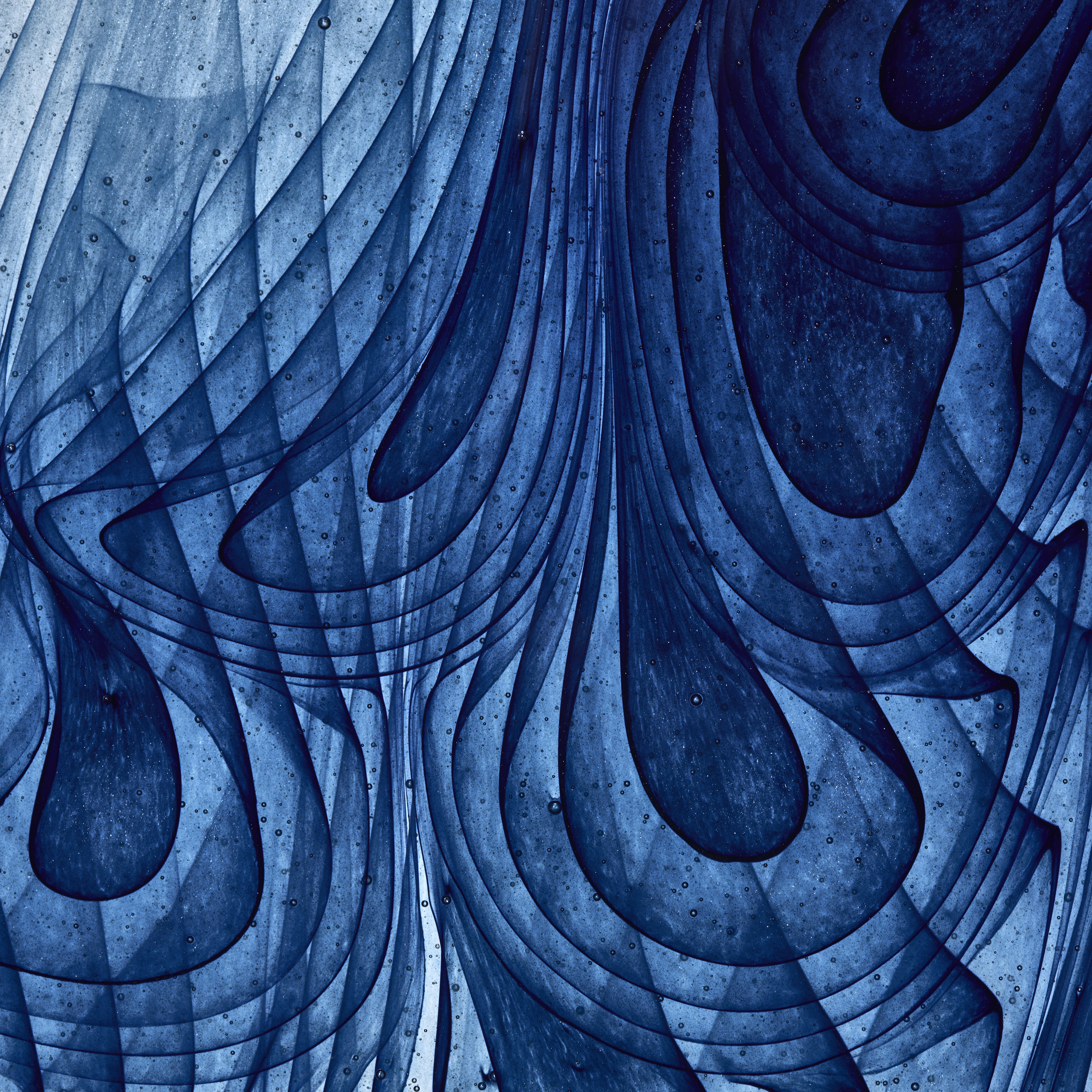
Taking much influence from her former career, Restorick methodically explores the properties and manipulation of kiln-formed glass, often referencing biological or medical themes. Primarily exploring flow patterns in glass, Restorick is fascinated in the movement and displacement that occurs during the casting process, when glass is heated allowing it to become viscous, yielding to reshaping via the use of moulds.
![]()
Sketchbook & working through ideas, image courtesy of the artist
However, Restorick is not only interested in just these set of specific conditions she places her glass under, but also the effects of heat when combined with the pull of gravity on her softened glass. It is this crucial pairing that once harnessed, produces her arresting linear patterns, suspended within these solid yet translucent artworks.
![]()
Colour tests, image courtesy of the artist
Additionally, echoing aspects of her former career, Restorick has established a link between the movement of molten glass to that of other viscous fluids, such as blood. By using a little fluid dynamics knowledge, she can determine via form of flow, whether the end result will have a laminar (steady) or a turbulent design. She has discovered that the slightest adjustment to certain variables, by layering and directing the flow, can immensely affect the outcome, resulting in novel and dynamic patterns. With her continuing glass investigations, there is much anticipation as to what she will further discover and the new characteristics that her glass is yet to reveal.
![]()
The artist's kiln, image courtesy of the artist
In the artist’s own words:
“Finding glass as a medium to create with has been part of a rewarding and fulfilling journey for me. It has been a way of developing part of my identity beyond my previous career in medicine. I think inevitably, I have incorporated many aspects of related disciplines into my artwork and it has been important part of the process for me.”
Helen Restorick lives and works in Surrey. Having completed her MA in Glass at the University for the Creative Arts, she is currently continuing her research there. She has exhibited in the UK, Germany and the USA.
![]()
Discussion with the artist
Having started your glass career later in life, what did you do beforehand?
My first vocation was medicine. During my time at medical school in London, I also studied for a degree in Human Genetics. I was then a partner in general practice for many years. I also worked at St Georges Hospital in the Genetics Department for a time. Working in medicine was an absolute privilege. I loved my time in practice and still miss my patients. It was a difficult decision to leave but the time was right for me to begin a whole new area of my life when the world of glass art called.
How did you get started in glass and what ‘drew’ you to the material?
I always loved art at school, but I think inevitably I had to focus on different things to study medicine. I did continue to use my box of watercolours but only as a hobby. When I was gifted a workshop day working with glass nearly a decade ago, I took the opportunity. It was totally addictive! I just fell in love. I think I immediately took to the technical challenge of the media - but also I was just captivated by the innate beauty of the material. It was a wonderful expressive outlet which I felt absolutely compelled by. I searched for adult education classes to give me a foundation in subject. Richmond Art School was a fantastic find. Then on to a degree after that. I knew I had found my next calling from day one really.
![]()
The artist's new instruments, image courtesy of the artist
What do you find to be the most challenging aspect of your practice?
I think most glass artists would say the same - it’s a demanding material to work with. Just when you think every variable is covered something else moves in to thwart you in a different way! Of course, it’s often when things go wrong that a new idea or pleasing result emerge. That’s all part of joy of the experience - and finding a meaningful piece of art through that journey is the goal.
To date, what has been your ‘glass career’ high?
Probably seeing two channels of flow interact together for the first time in the glass and thinking wow, that’s so beautiful! Apart from the satisfaction of the work itself, then it would have to be completing my Master’s degree I think.
![]()
The artist drawing, image courtesy of the artist
How do you feel about the state of British art glass today?
I feel cautiously optimistic. The positives reflect what I think is a talented, friendly cohesive group of artists. The glass community has been a strong, welcoming one as far as I am concerned. On the other hand, I’m afraid the diminishing state of undergraduate and post graduate opportunities is so disappointing. For those who are graduating the landscape out there is a tough one.
Which living glass artist do you most admire and why?
Colin Reid, for his beautiful cast pieces which are optically perfect. He consistently produces stunning work. Cathyrn Shilling, her work, I particularly love the classic forms of her Cloaked series but I would also say she is someone who seems to be able to have an inclusive voice for everyone in the glass world. I must just mention Dominic Labino, he died in the late 1980s, but his Emergence series is particularly noteworthy for me. I first spotted a piece of his work in a cabinet at the V&A museum. A stunning example of flow patterns made in the hot shop. He was an innovator in both industry and art. He was involved in the production and development of fibre glass, including that used as insulation for NASA’s space program. He was a founder of the studio glass movement in the US. A great example of a scientist and an artist.
![]()
Cloaked Collection by Cathryn Shilling, image © Ester Segarra
If you could collaborate with any artist, from any background, who would that be and why?
So, at this moment in time may I collaborate with a mathematician or material scientist instead please? I’m trying to explore the fluid dynamics of viscous materials in more depth and how I can apply that knowledge successfully. I think I need to take a deep dive into the area with an expert. However, if I were able to choose any artist at any point in time, then perhaps I would collaborate with Helen Frankenthaler. She was an abstract expressionist painter working mainly in the latter half of the twentieth century. Known as a colour field painter, she worked on large, horizontal canvases using varying techniques to soak and cover the surface with layers of colour. Her painterly results were uniquely expressive. It would have been fascinating to connect the flow in my glass with the free-flowing areas of colour in her work.
Can you share any future plans? Either ones set in stone or something you would love to make happen?
I intend to continue exploring to see what I can achieve by manipulating the fluidity of glass through my current academic research. I’m very fortunate to have just started back at the University for the Creative Arts doing just that. I’m deciding where I want my studies to head. Creatively pushing the flow patterns further is the plan.
![]()
Helen Restorick with her kiln, image courtesy of the artist
Explore the artist's portfolio
![]()
Artworks by Helen Restorick
Artwork photography © Agata Pec
Introspection
Unique | H 29.5 cm W 39.5 cm D 3.5 cm
![]()
![]()
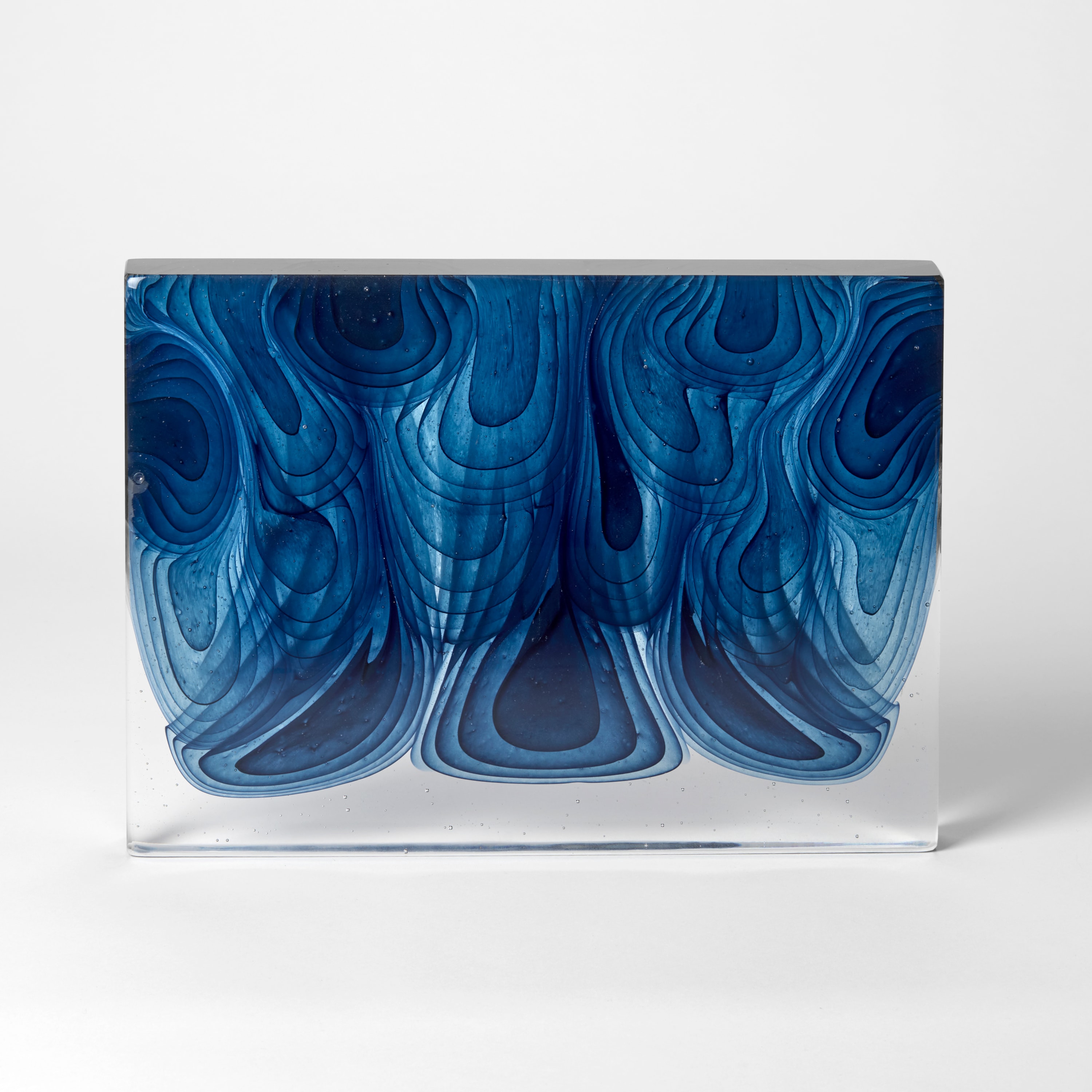
Infusion
Unique | H 24.5 cm W 33 cm D 3.5 cm
![]()
![]()
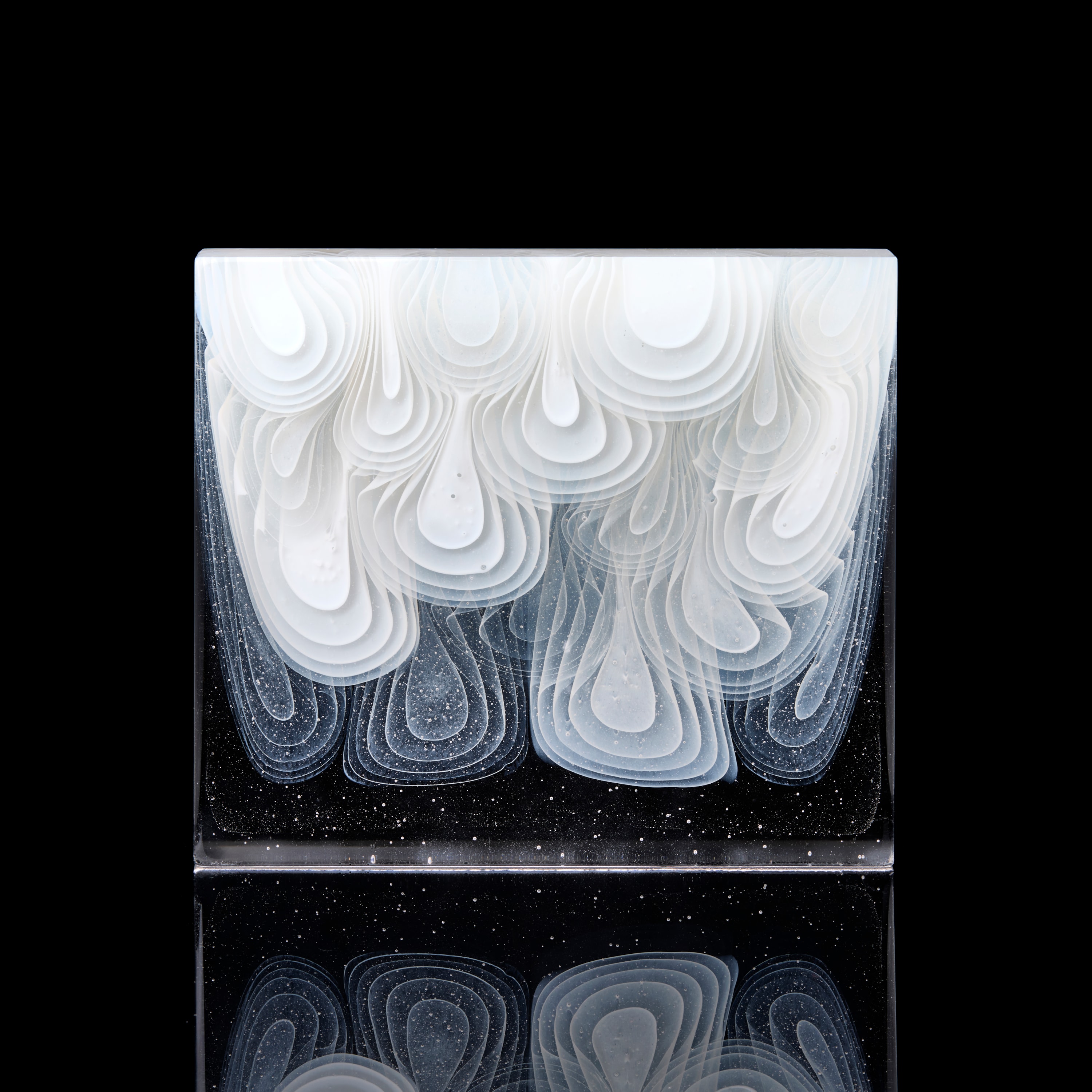
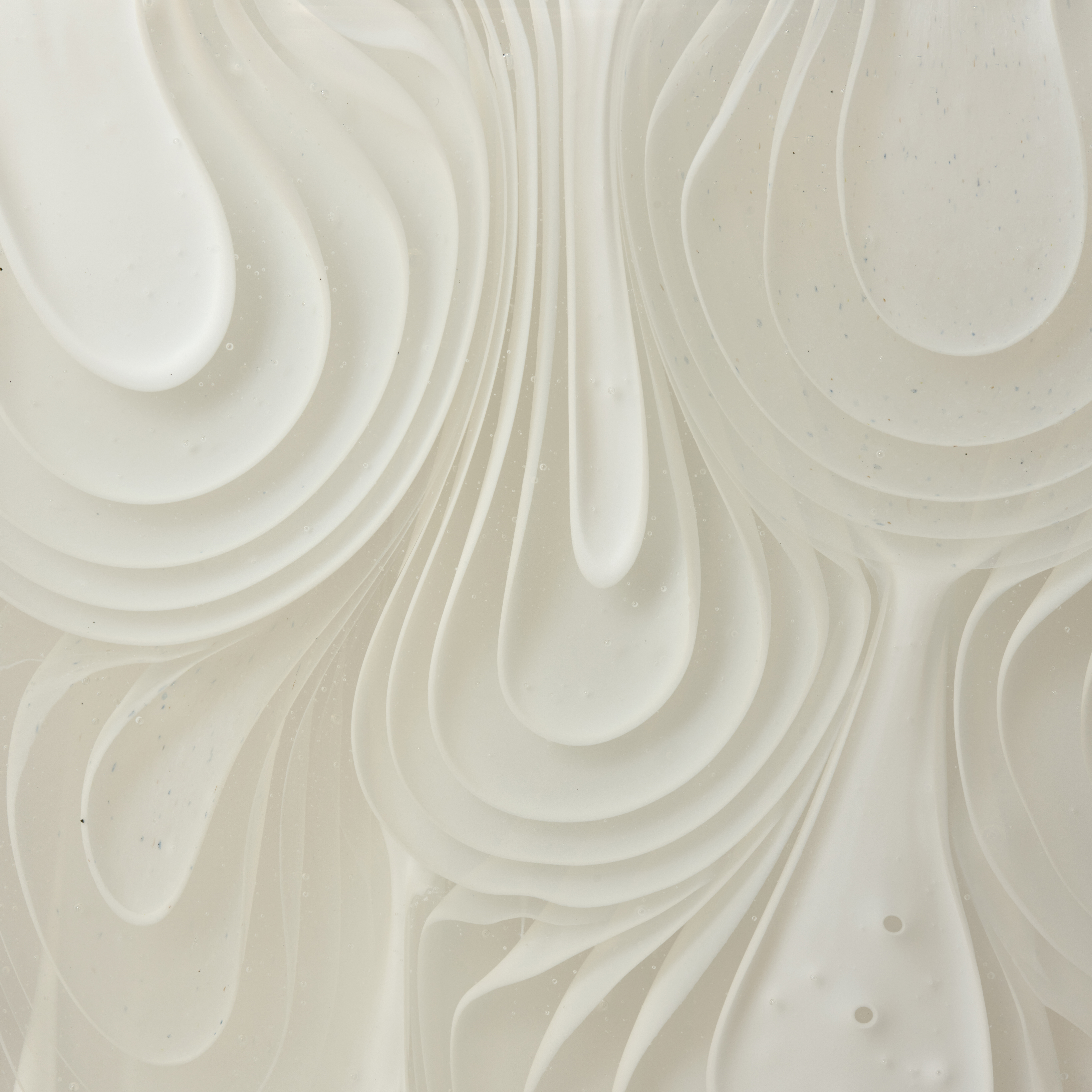
Opaline Infusion
Unique | H 26 cm W 29 cm D 3.5 cm
![]()
![]()
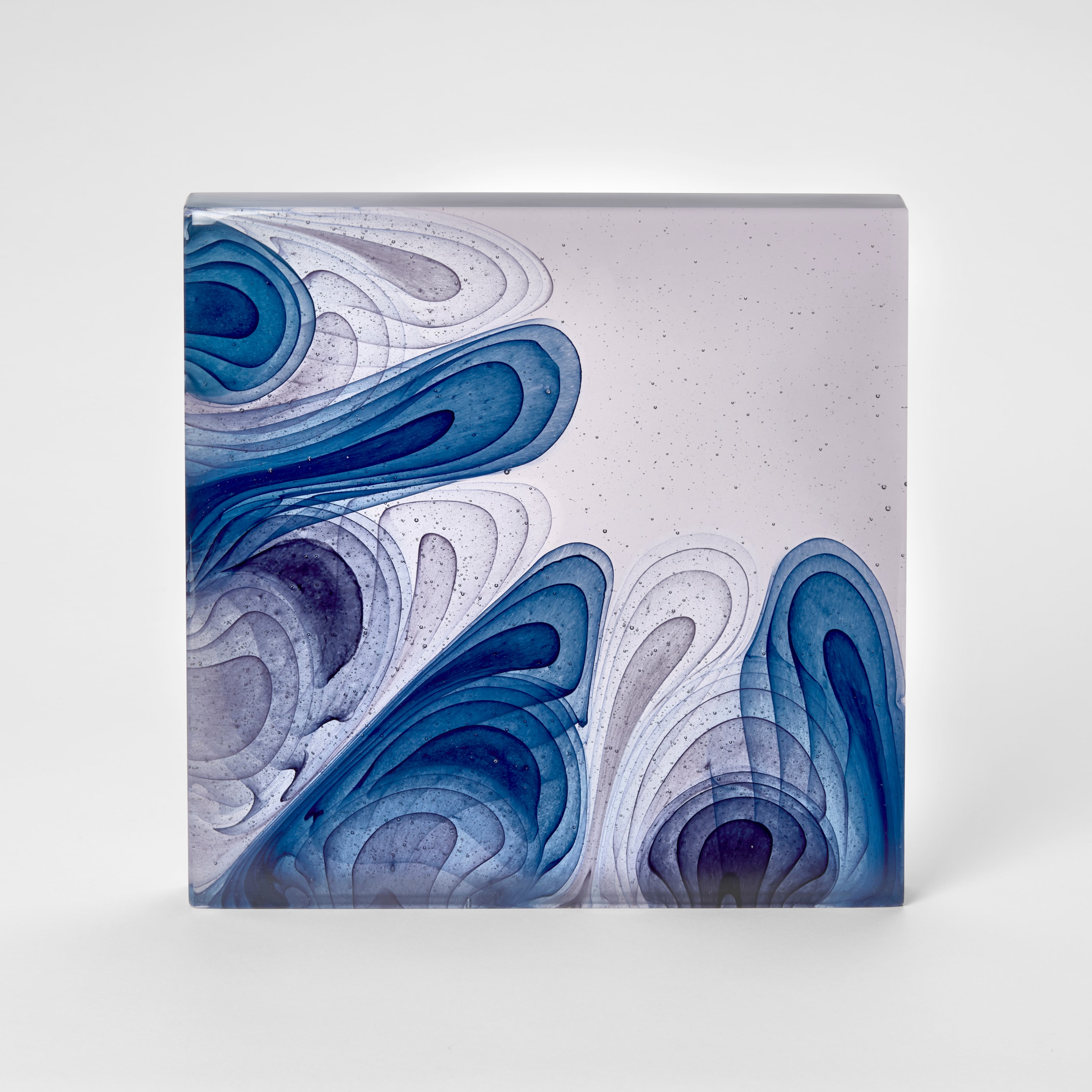
Lavender Interaction
Unique | H 29 cm W 29 cm D 4 cm
![]()
![]()
Monochrome Interaction
Unique | H 26.5 cm W 26.5 cm D 3 cm
![]()
![]()
Blue Drift II
Unique | H 23.5 cm W 32 cm D 3.5 cm
![]()
![]()
Having initially studied medicine and genetics, Helen Restorick moved her attention away from science to art, culminating in her studying for her MA in glass at the University for the Creative Arts, Farnham, in 2023. Often perceived as vastly differing, the scientific and the artistic are firmly connected, with examples to be found both historically, as well as in a more contemporary light. Therefore, this change in direction is not so unusual as it first might seem.
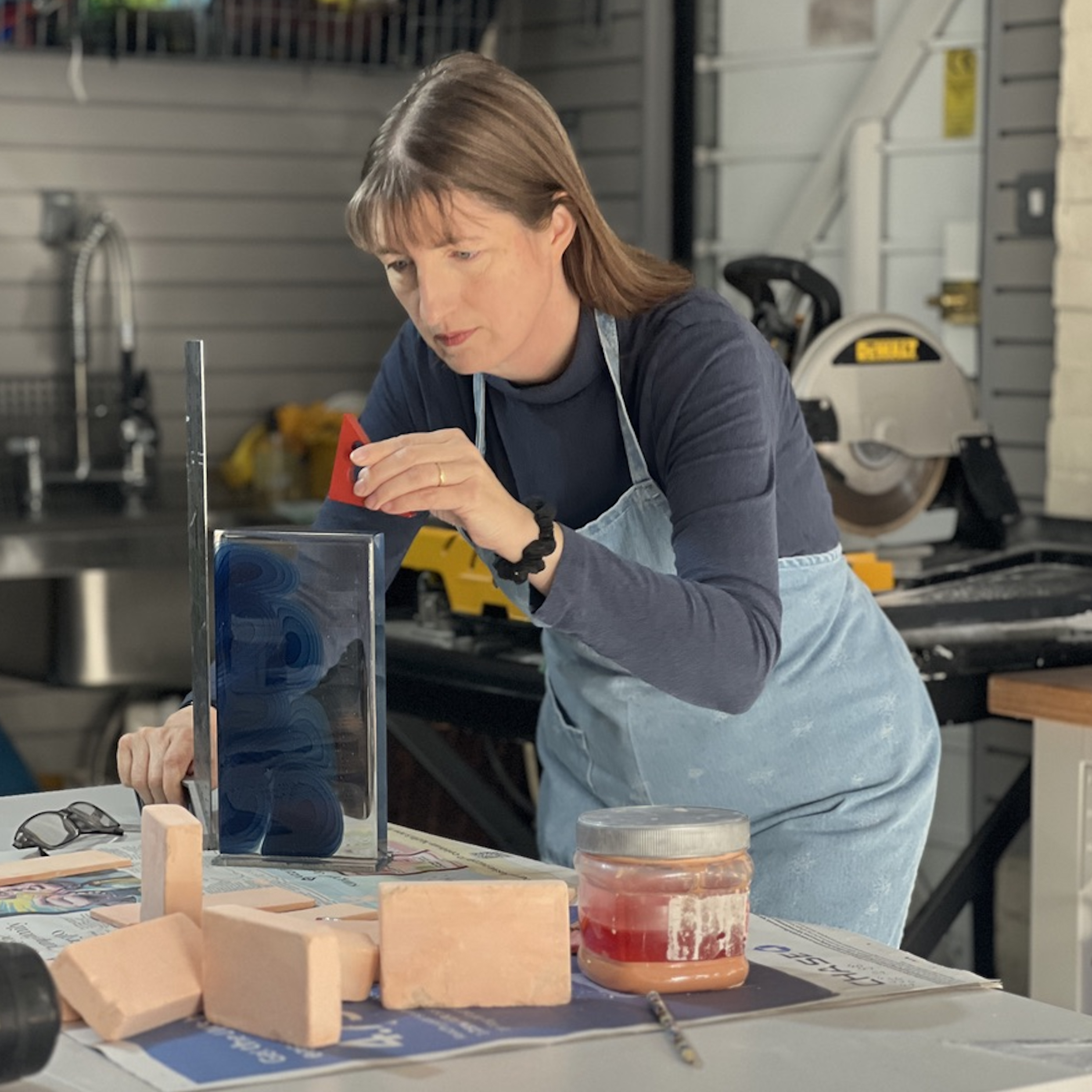
Helen Restorick, image courtesy of the artist
Taking much influence from her former career, Restorick methodically explores the properties and manipulation of kiln-formed glass, often referencing biological or medical themes. Primarily exploring flow patterns in glass, Restorick is fascinated in the movement and displacement that occurs during the casting process, when glass is heated allowing it to become viscous, yielding to reshaping via the use of moulds.
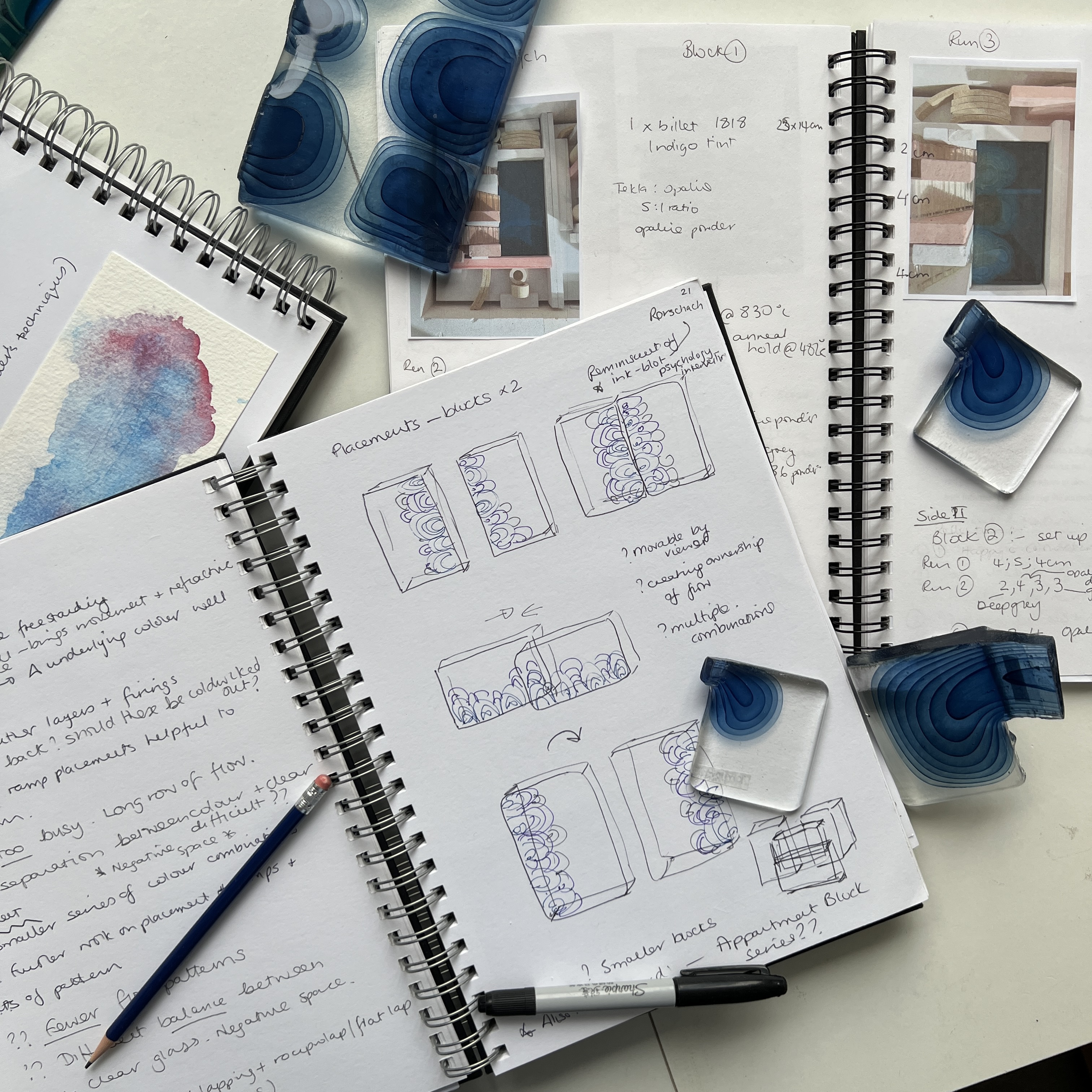
Sketchbook & working through ideas, image courtesy of the artist
However, Restorick is not only interested in just these set of specific conditions she places her glass under, but also the effects of heat when combined with the pull of gravity on her softened glass. It is this crucial pairing that once harnessed, produces her arresting linear patterns, suspended within these solid yet translucent artworks.
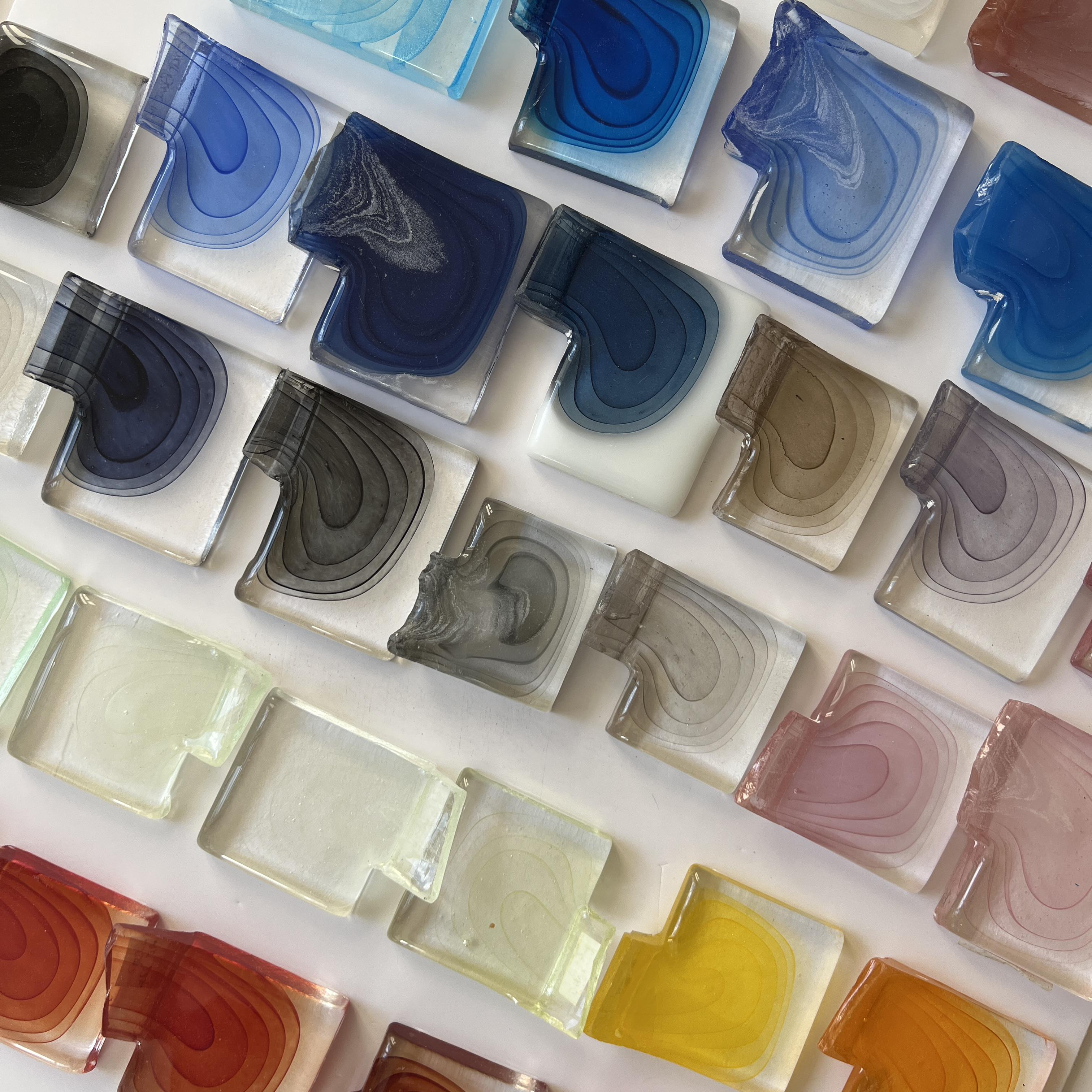
Colour tests, image courtesy of the artist
Additionally, echoing aspects of her former career, Restorick has established a link between the movement of molten glass to that of other viscous fluids, such as blood. By using a little fluid dynamics knowledge, she can determine via form of flow, whether the end result will have a laminar (steady) or a turbulent design. She has discovered that the slightest adjustment to certain variables, by layering and directing the flow, can immensely affect the outcome, resulting in novel and dynamic patterns. With her continuing glass investigations, there is much anticipation as to what she will further discover and the new characteristics that her glass is yet to reveal.
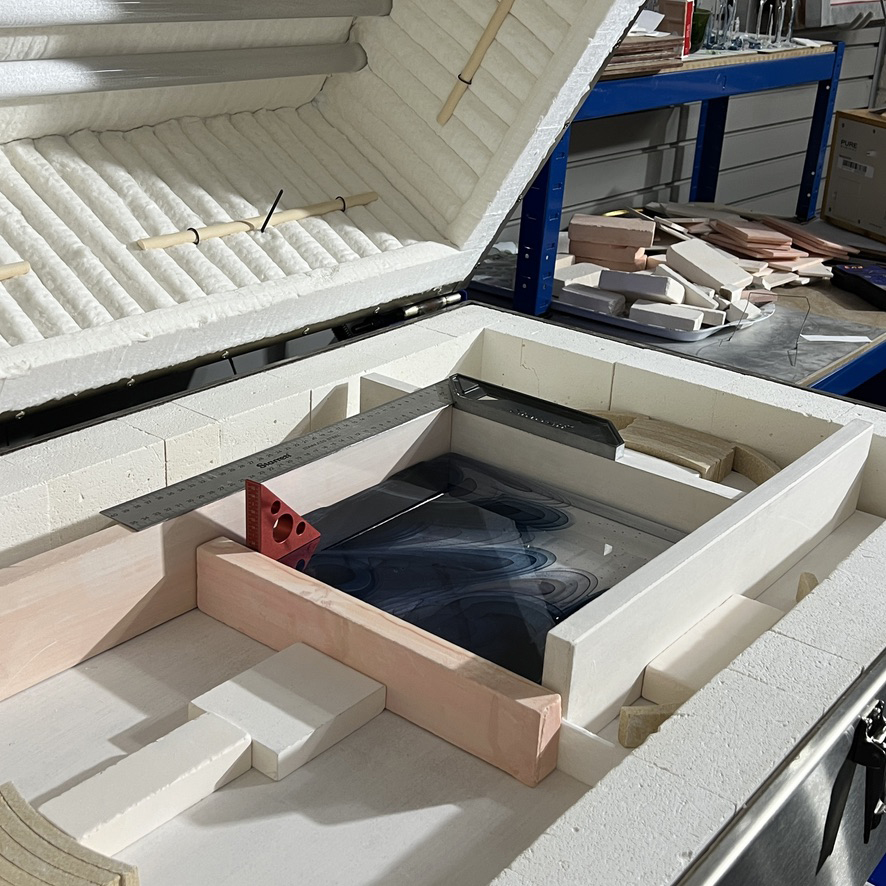
The artist's kiln, image courtesy of the artist
In the artist’s own words:
“Finding glass as a medium to create with has been part of a rewarding and fulfilling journey for me. It has been a way of developing part of my identity beyond my previous career in medicine. I think inevitably, I have incorporated many aspects of related disciplines into my artwork and it has been important part of the process for me.”
Helen Restorick lives and works in Surrey. Having completed her MA in Glass at the University for the Creative Arts, she is currently continuing her research there. She has exhibited in the UK, Germany and the USA.

Discussion with the artist
Having started your glass career later in life, what did you do beforehand?
My first vocation was medicine. During my time at medical school in London, I also studied for a degree in Human Genetics. I was then a partner in general practice for many years. I also worked at St Georges Hospital in the Genetics Department for a time. Working in medicine was an absolute privilege. I loved my time in practice and still miss my patients. It was a difficult decision to leave but the time was right for me to begin a whole new area of my life when the world of glass art called.
How did you get started in glass and what ‘drew’ you to the material?
I always loved art at school, but I think inevitably I had to focus on different things to study medicine. I did continue to use my box of watercolours but only as a hobby. When I was gifted a workshop day working with glass nearly a decade ago, I took the opportunity. It was totally addictive! I just fell in love. I think I immediately took to the technical challenge of the media - but also I was just captivated by the innate beauty of the material. It was a wonderful expressive outlet which I felt absolutely compelled by. I searched for adult education classes to give me a foundation in subject. Richmond Art School was a fantastic find. Then on to a degree after that. I knew I had found my next calling from day one really.
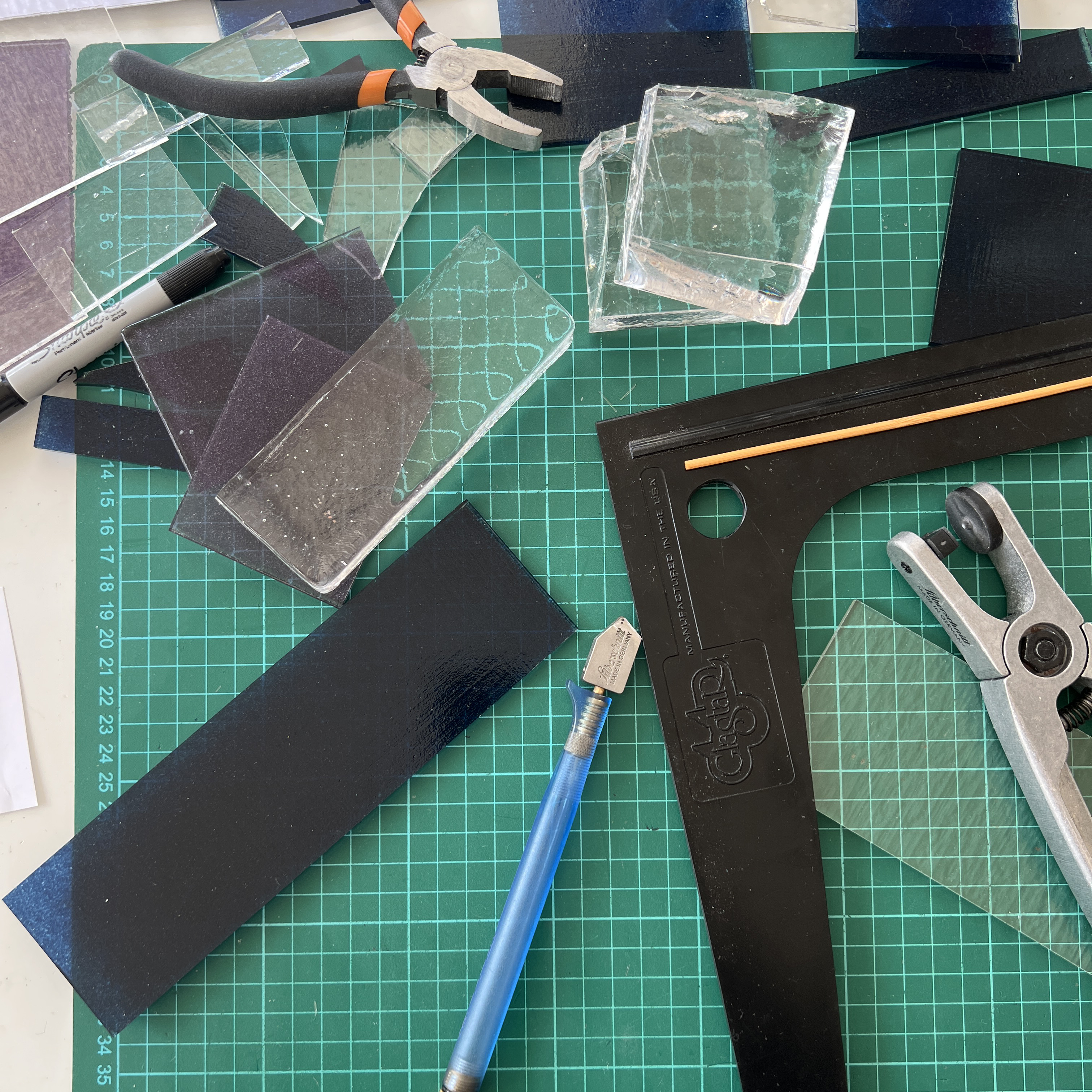
The artist's new instruments, image courtesy of the artist
What do you find to be the most challenging aspect of your practice?
I think most glass artists would say the same - it’s a demanding material to work with. Just when you think every variable is covered something else moves in to thwart you in a different way! Of course, it’s often when things go wrong that a new idea or pleasing result emerge. That’s all part of joy of the experience - and finding a meaningful piece of art through that journey is the goal.
To date, what has been your ‘glass career’ high?
Probably seeing two channels of flow interact together for the first time in the glass and thinking wow, that’s so beautiful! Apart from the satisfaction of the work itself, then it would have to be completing my Master’s degree I think.
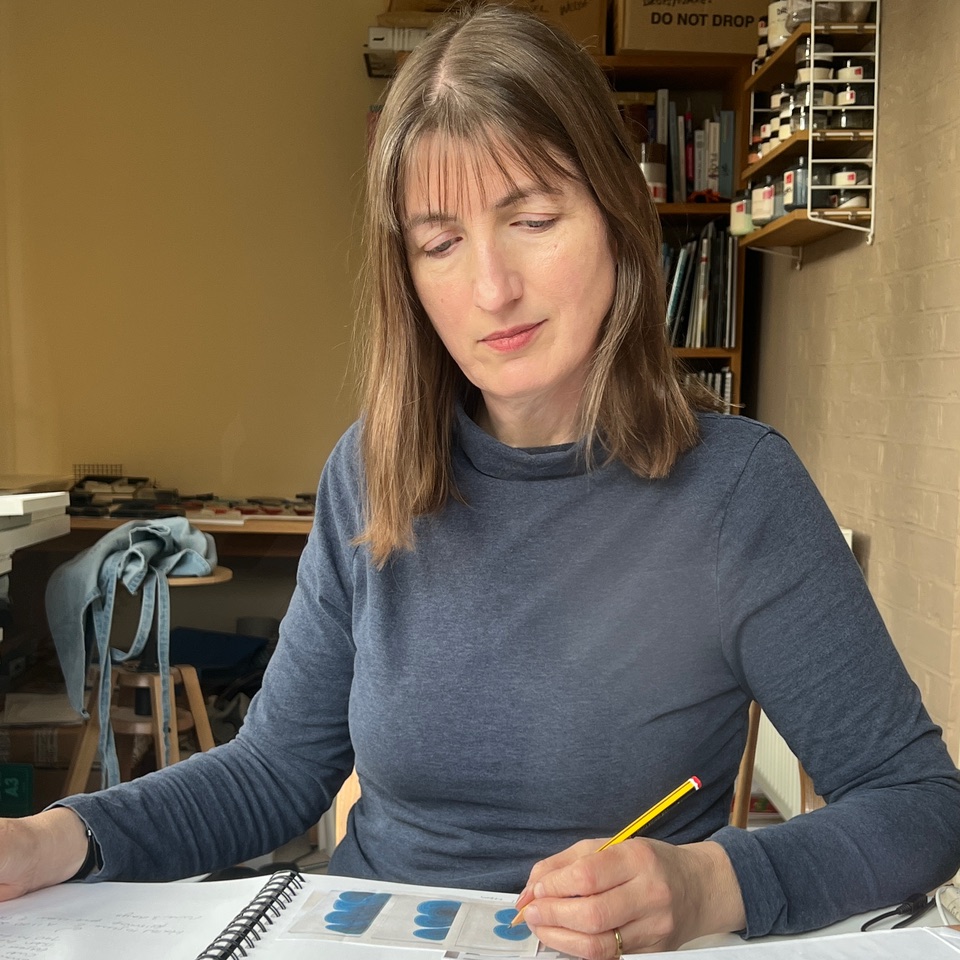
The artist drawing, image courtesy of the artist
How do you feel about the state of British art glass today?
I feel cautiously optimistic. The positives reflect what I think is a talented, friendly cohesive group of artists. The glass community has been a strong, welcoming one as far as I am concerned. On the other hand, I’m afraid the diminishing state of undergraduate and post graduate opportunities is so disappointing. For those who are graduating the landscape out there is a tough one.
Which living glass artist do you most admire and why?
Colin Reid, for his beautiful cast pieces which are optically perfect. He consistently produces stunning work. Cathyrn Shilling, her work, I particularly love the classic forms of her Cloaked series but I would also say she is someone who seems to be able to have an inclusive voice for everyone in the glass world. I must just mention Dominic Labino, he died in the late 1980s, but his Emergence series is particularly noteworthy for me. I first spotted a piece of his work in a cabinet at the V&A museum. A stunning example of flow patterns made in the hot shop. He was an innovator in both industry and art. He was involved in the production and development of fibre glass, including that used as insulation for NASA’s space program. He was a founder of the studio glass movement in the US. A great example of a scientist and an artist.
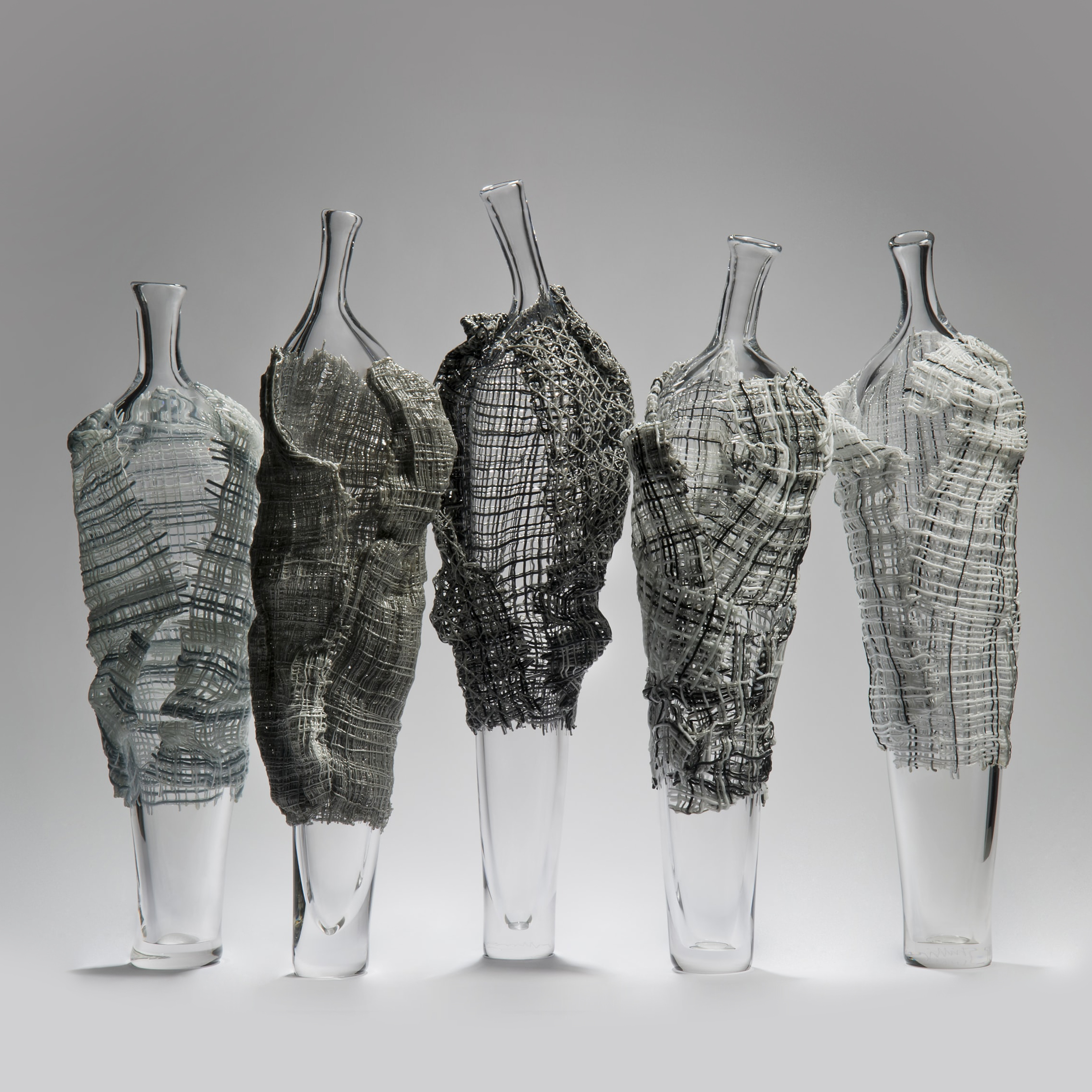
Cloaked Collection by Cathryn Shilling, image © Ester Segarra
If you could collaborate with any artist, from any background, who would that be and why?
So, at this moment in time may I collaborate with a mathematician or material scientist instead please? I’m trying to explore the fluid dynamics of viscous materials in more depth and how I can apply that knowledge successfully. I think I need to take a deep dive into the area with an expert. However, if I were able to choose any artist at any point in time, then perhaps I would collaborate with Helen Frankenthaler. She was an abstract expressionist painter working mainly in the latter half of the twentieth century. Known as a colour field painter, she worked on large, horizontal canvases using varying techniques to soak and cover the surface with layers of colour. Her painterly results were uniquely expressive. It would have been fascinating to connect the flow in my glass with the free-flowing areas of colour in her work.
Can you share any future plans? Either ones set in stone or something you would love to make happen?
I intend to continue exploring to see what I can achieve by manipulating the fluidity of glass through my current academic research. I’m very fortunate to have just started back at the University for the Creative Arts doing just that. I’m deciding where I want my studies to head. Creatively pushing the flow patterns further is the plan.
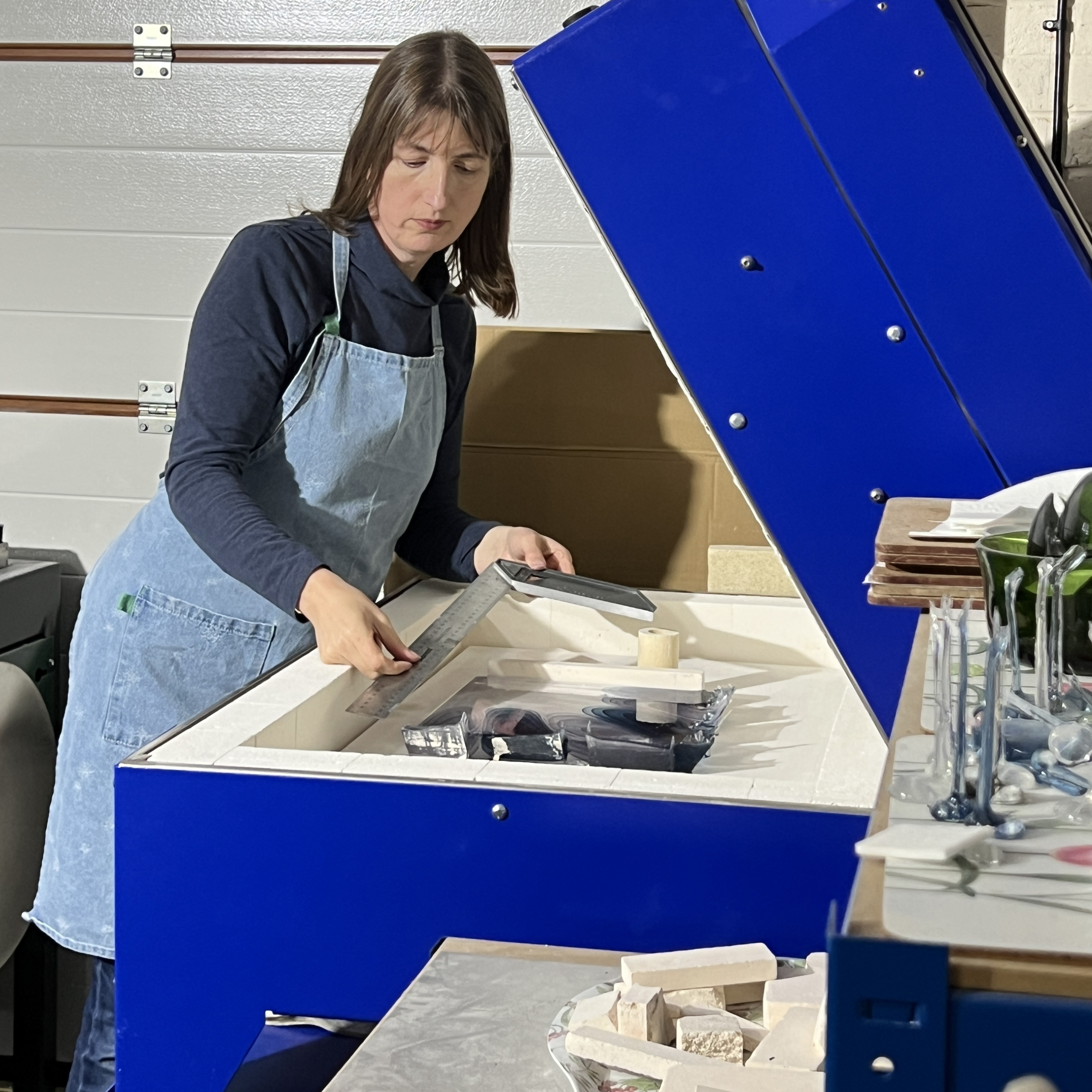
Helen Restorick with her kiln, image courtesy of the artist
Explore the artist's portfolio

Artworks by Helen Restorick
Artwork photography © Agata Pec
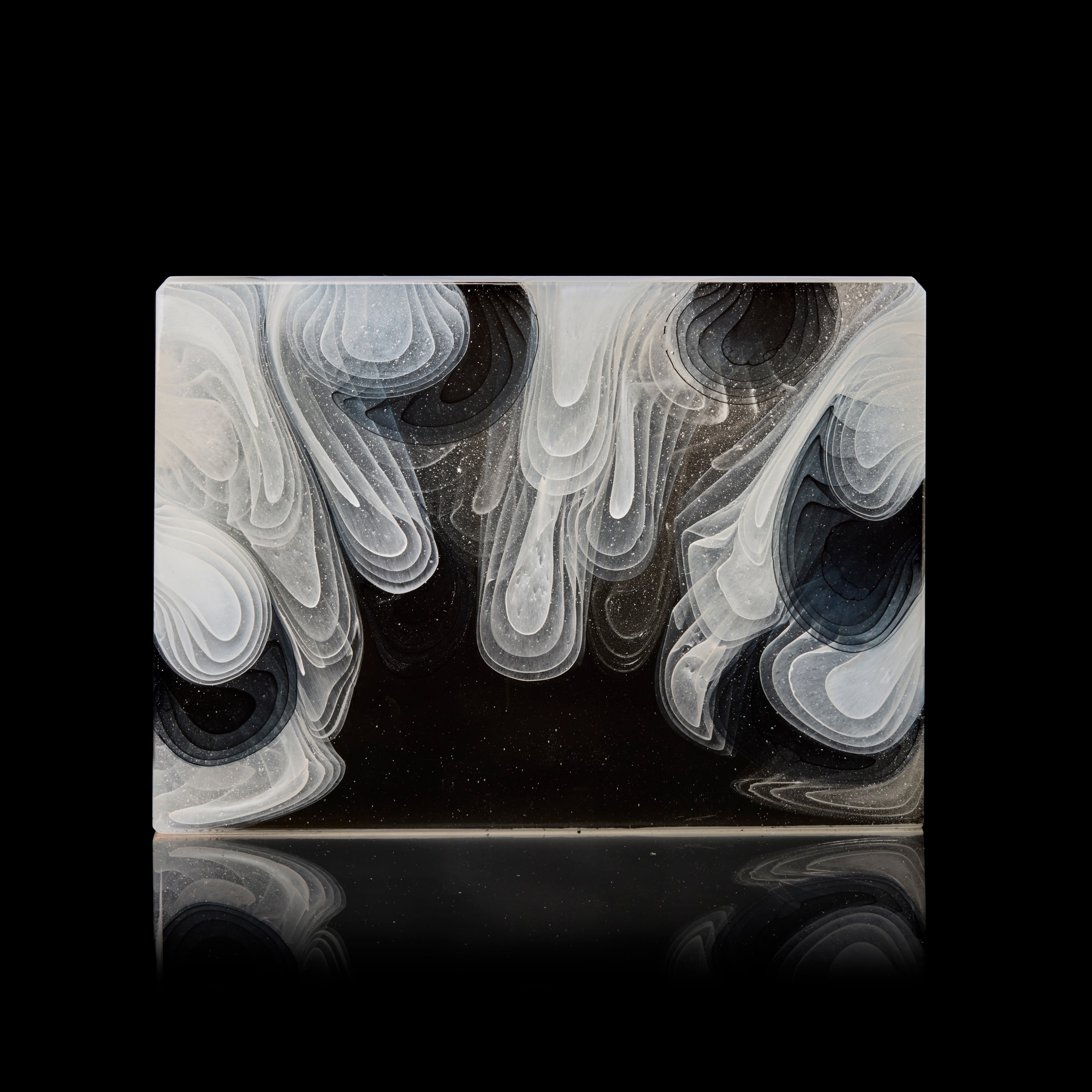
Introspection
Unique | H 29.5 cm W 39.5 cm D 3.5 cm
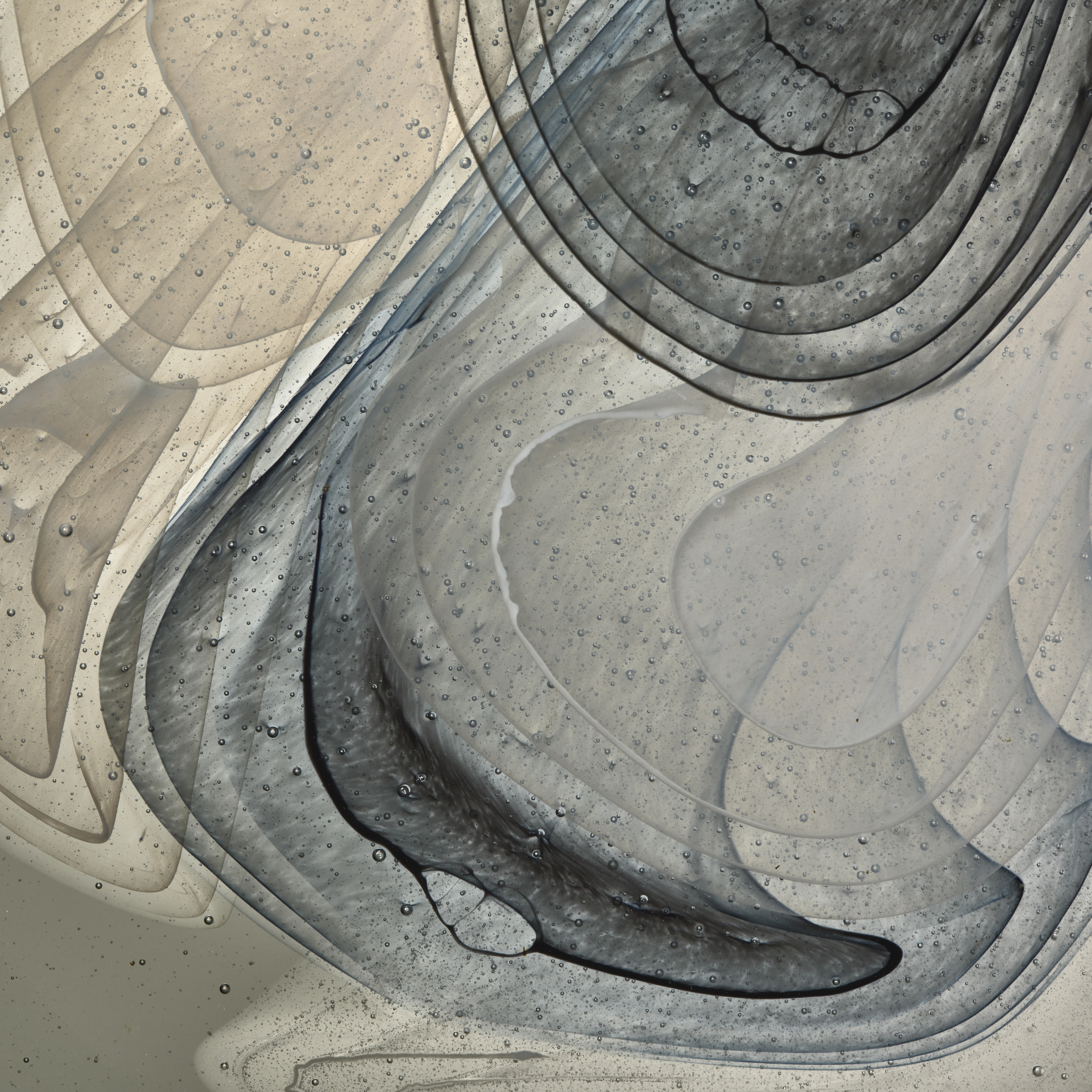
Infusion
Unique | H 24.5 cm W 33 cm D 3.5 cm

Opaline Infusion
Unique | H 26 cm W 29 cm D 3.5 cm
Lavender Interaction
Unique | H 29 cm W 29 cm D 4 cm
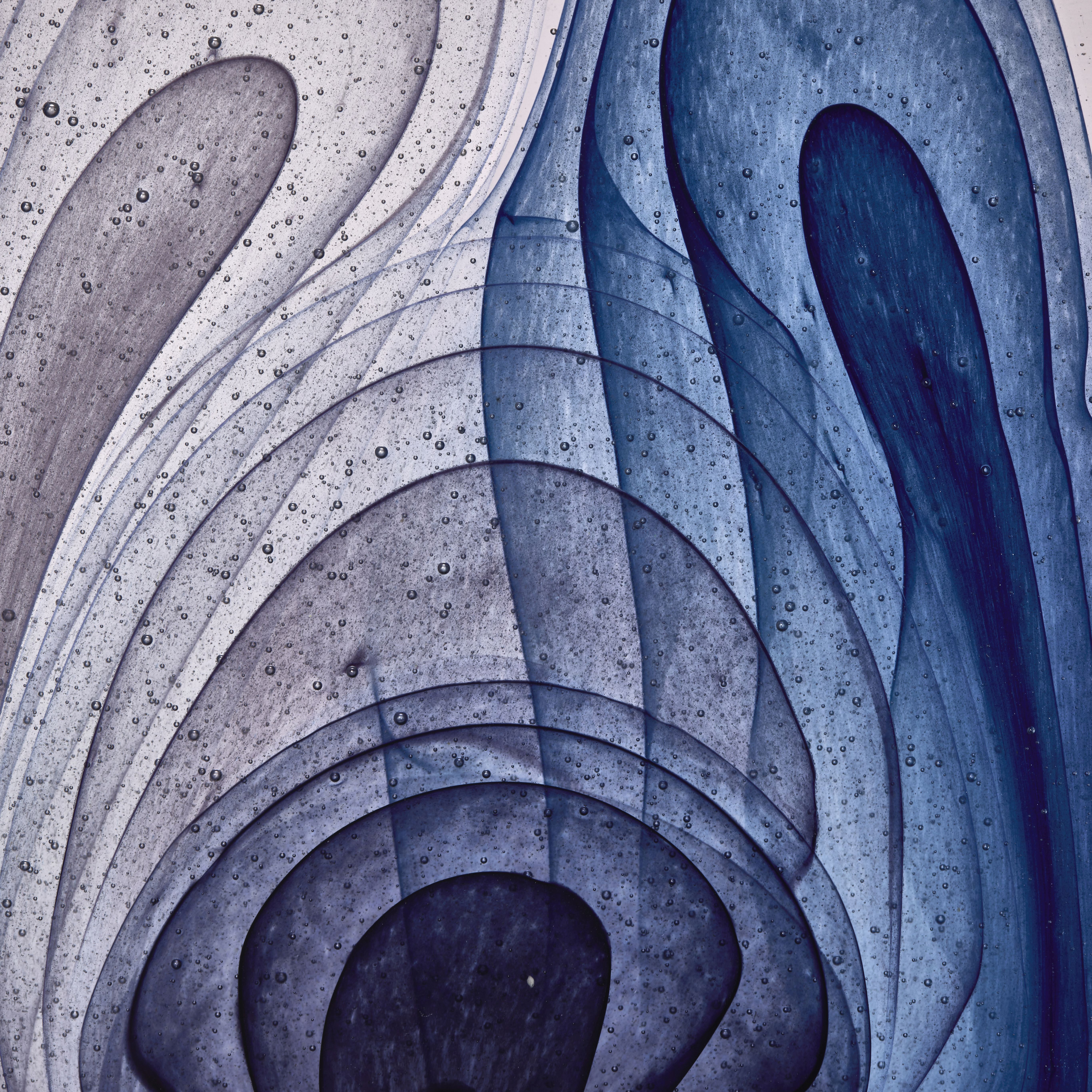
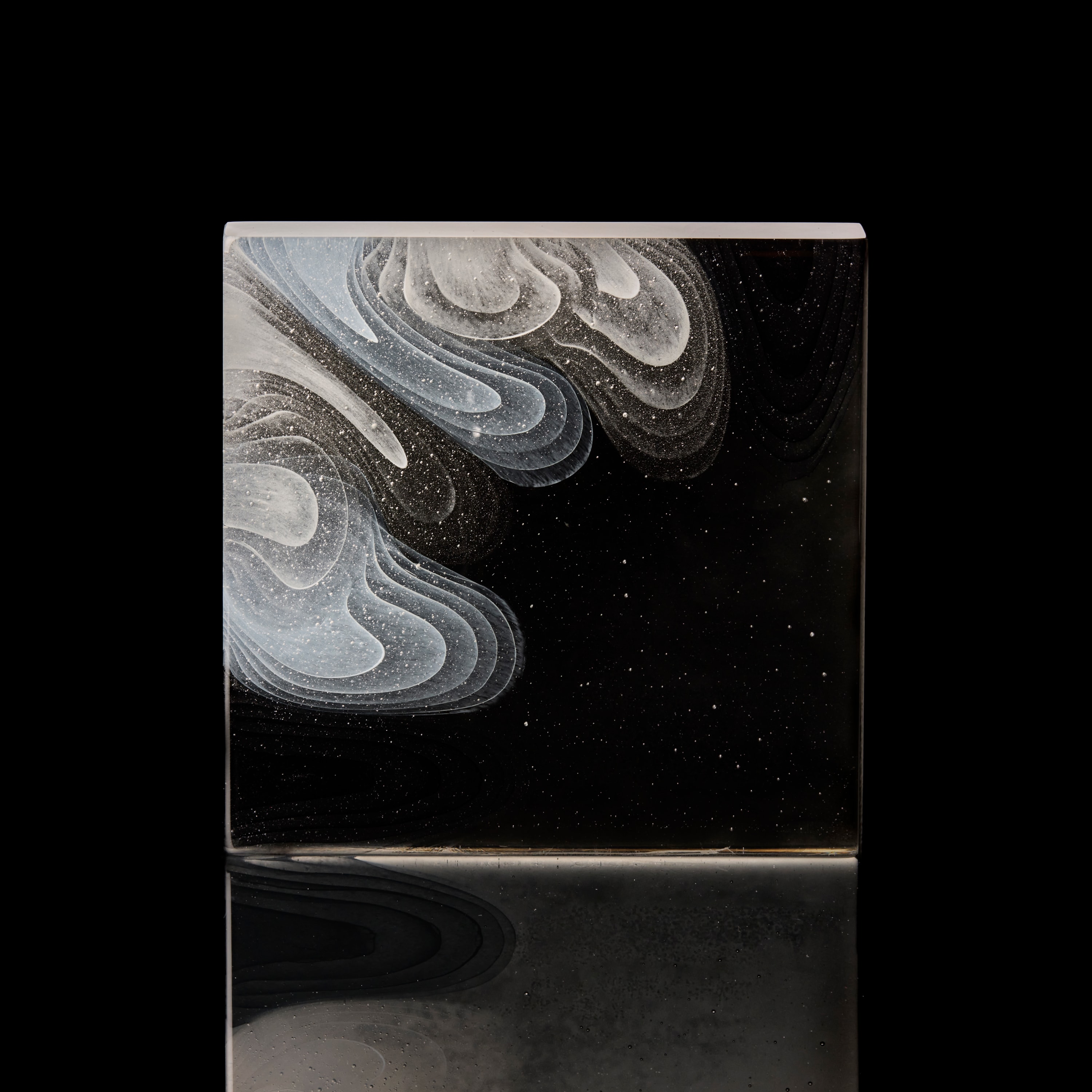
Monochrome Interaction
Unique | H 26.5 cm W 26.5 cm D 3 cm
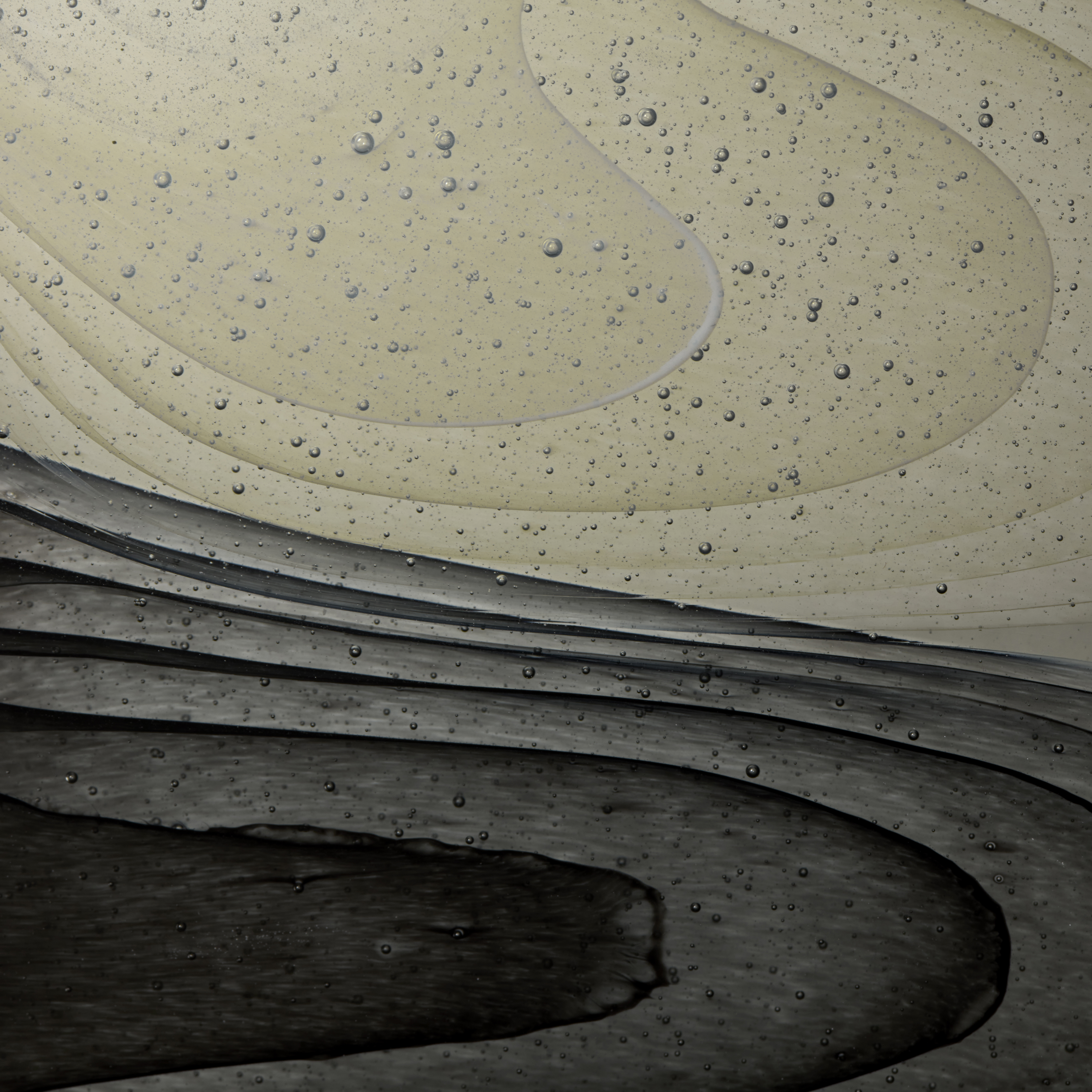
Blue Drift II
Unique | H 23.5 cm W 32 cm D 3.5 cm