

Stories Cast in Glass: Gensler x Chris Day | London Festival of Architecture
2nd June 2026

Stories Cast in Glass: Gensler x Chris Day | London Festival of Architecture | 1 - 30 June 2026
Curated by Gensler, SoShiro Gallery and Vessel Gallery, Stories Cast in Glass by Chris Day is presented as part of the London Festival of Architecture. By transforming Gensler's office lobby into a temporary gallery, this exciting change of use creates the opportunity for contemplation and dialogue, in what would otherwise be a transitory space.
Significantly, by connecting with its local community, the exhibition has been a catalyst for partnership with the Mulberry Academy London Dock, where in collaboration with the Gensler product design team, year 8 students have been invited to visit, explore the artworks on show and create their own ‘object of belonging’.
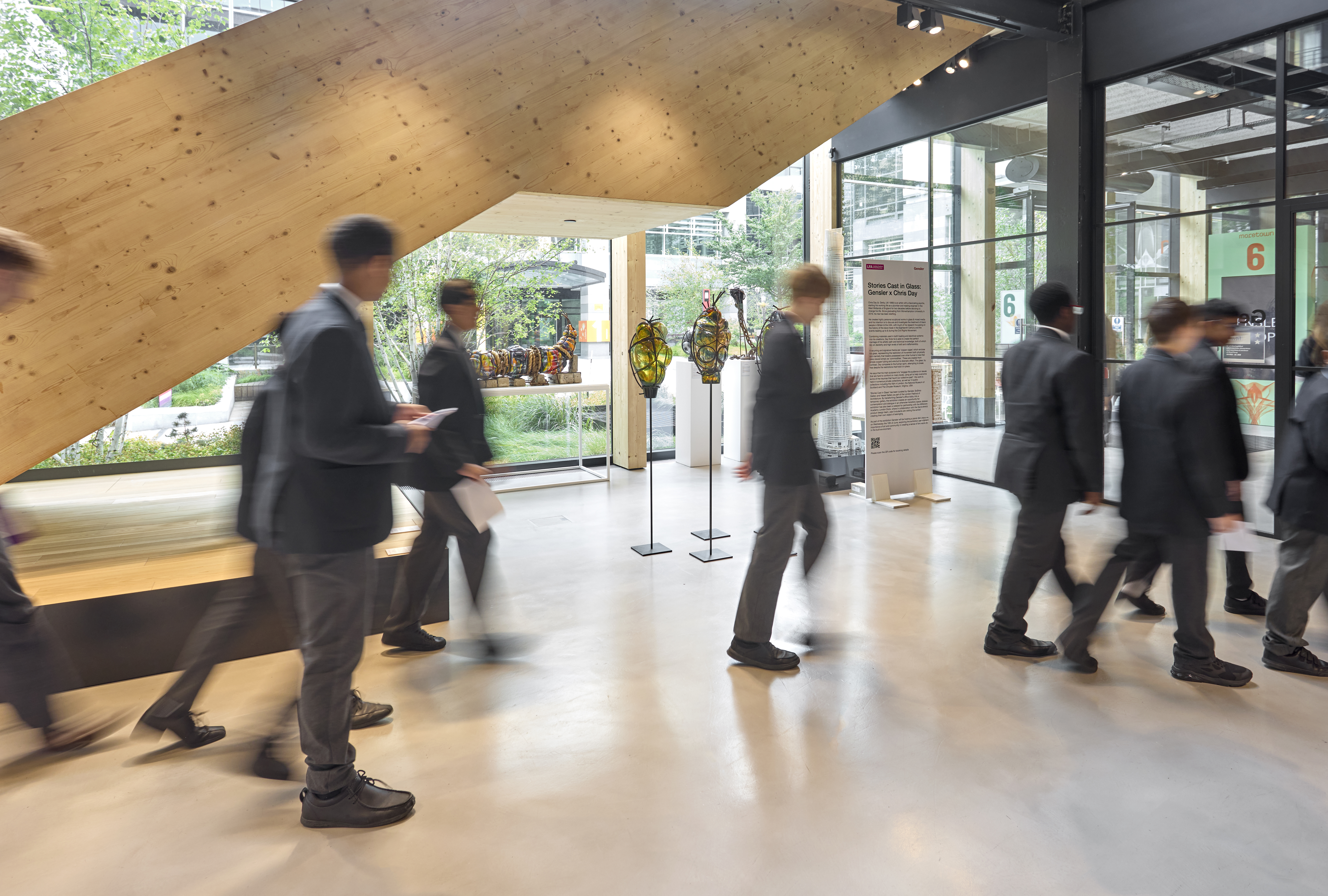
Mulberry Academy London Dock students visiting the exhibition
As part of the month-long showcase, Gensler will be hosting a panel discussion on Wednesday the 10th of June at 6pm, which will allow visitors to view the exhibition, whilst considering the important role of art and community, in creating a sense of belonging in the built environment.
Free panel discussion booking required
Further artworks by Chris Day
Stories Cast in Glass: Gensler x Chris Day
Gensler London
Moretown (formerly Thomas More Square)
London, E1W 1YW
Exhibition dates: 1 - 30 June 2026
If you are unable to visit in person, we invite you to discover and learn about the artworks on show...

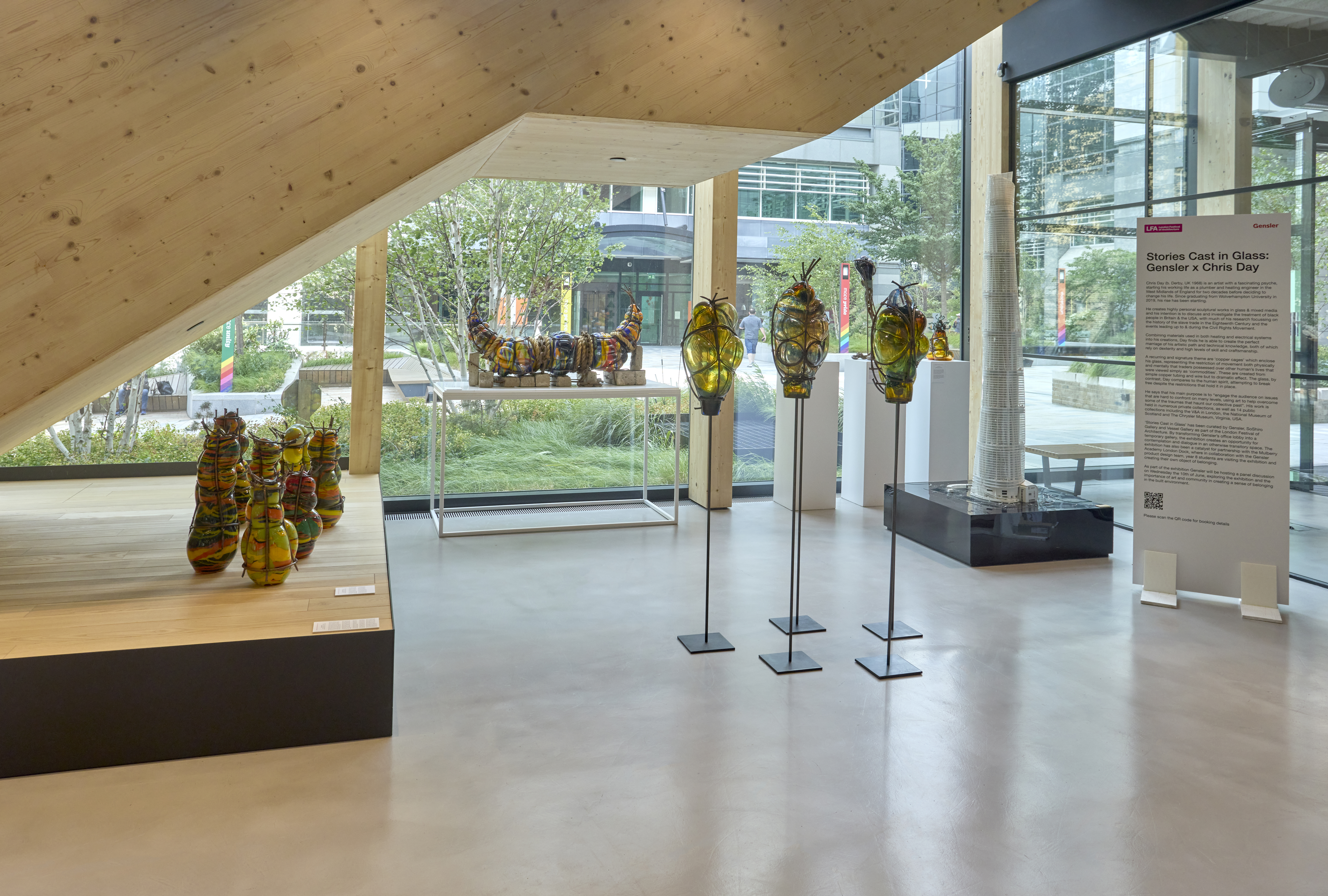
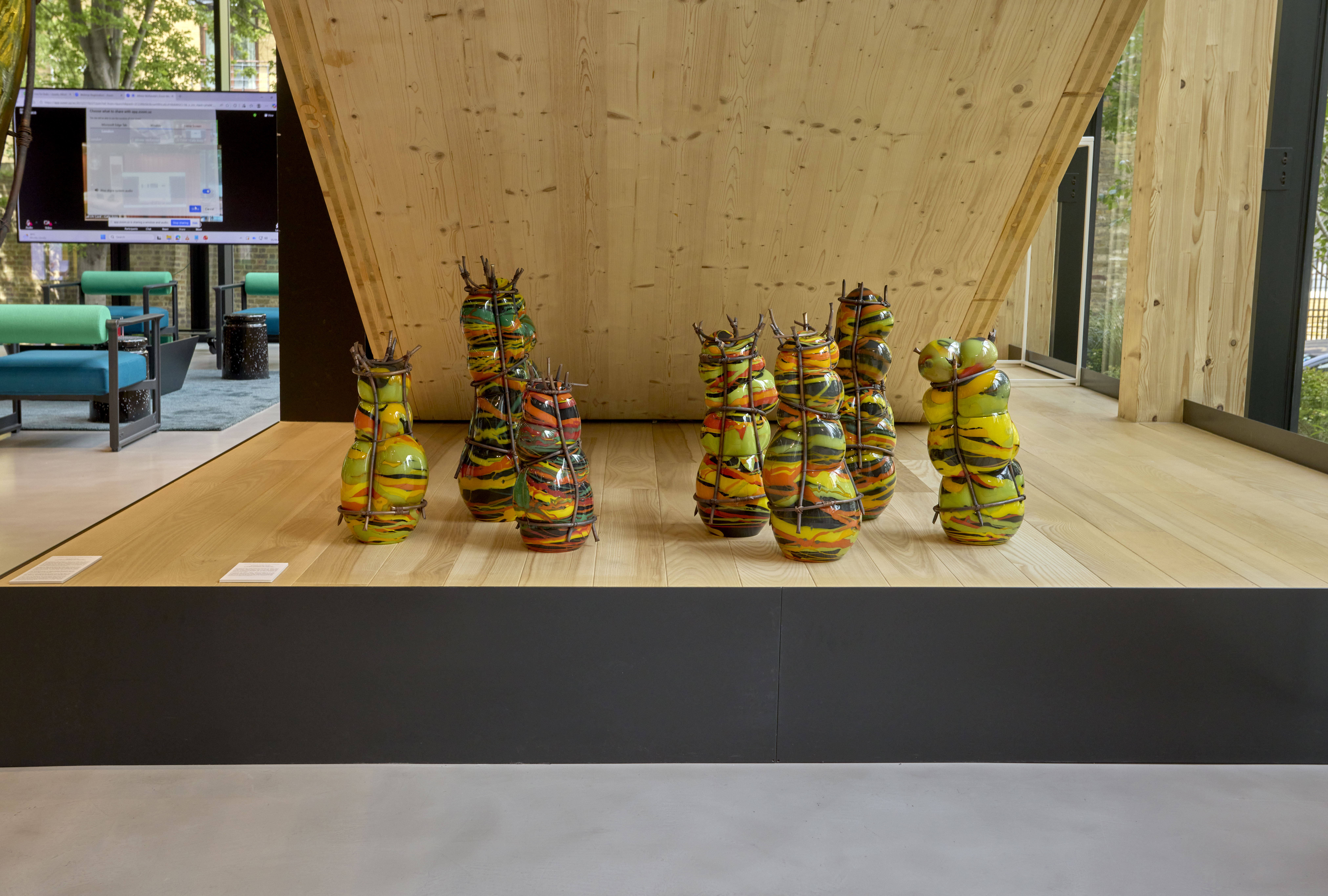
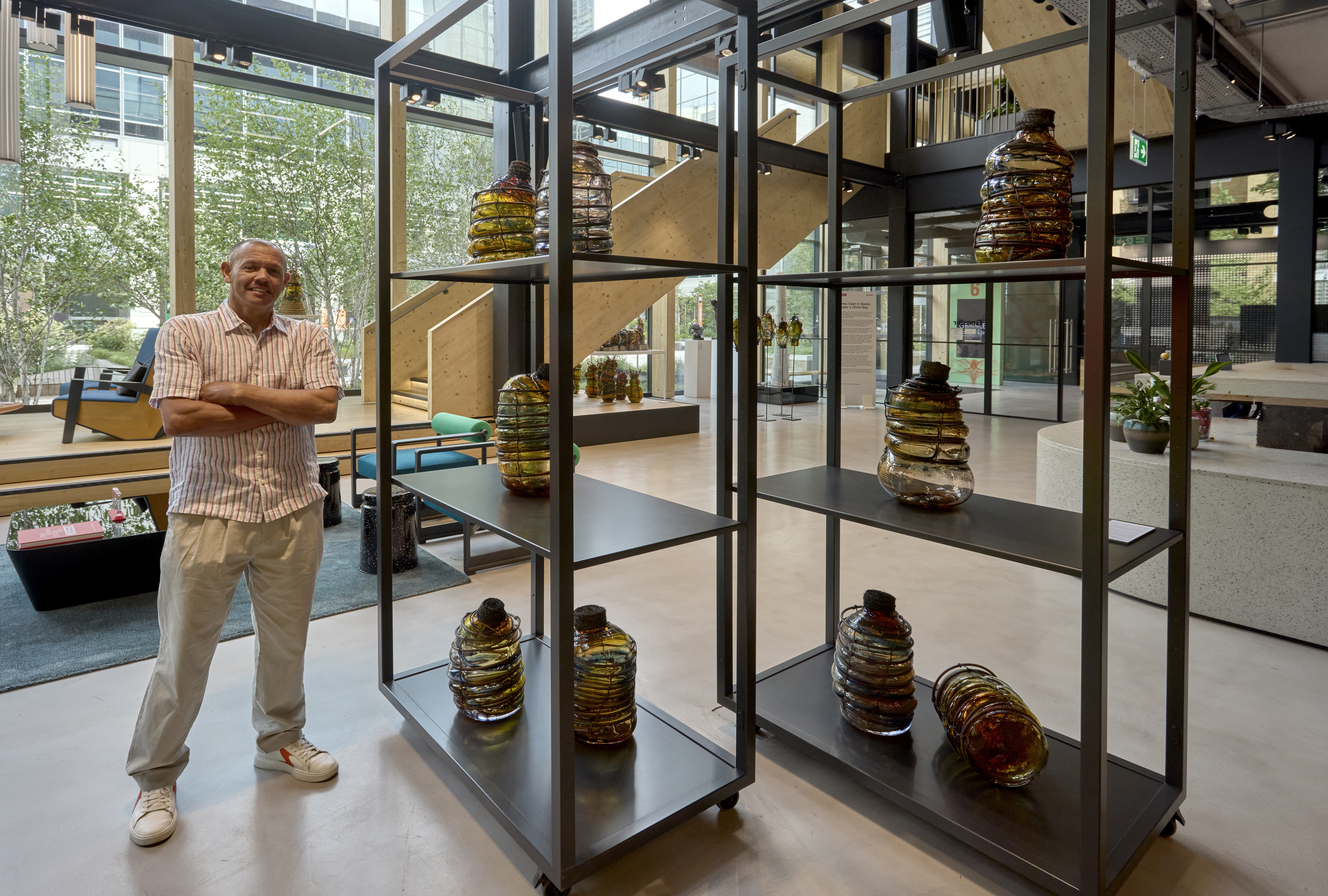
Transition of Age Series (Shown above)
Unique installation
Blown & sculpted glass with copper pipe
Considered his most personal artworks to date, Day’s Transition of Age series are inspired by the artist’s own experiences having been born of mixed parentage in the 1960’s and growing up in the UK. Using his palette to reflect his heritage, the colours reference the flags of Africa and Jamaica, with the black, poignantly, representing people.
Conceived in 2023 whilst artist-in-residence at the prestigious Museum of Glass, Tacoma, USA, Day joins an illustrious list of glass artists to have had this unique opportunity. Spanning two weeks, the time allowed Day to take his art in new directions. On finishing his residency, Transition of Age TE01 was selected for inclusion in the museum’s permanent collection.
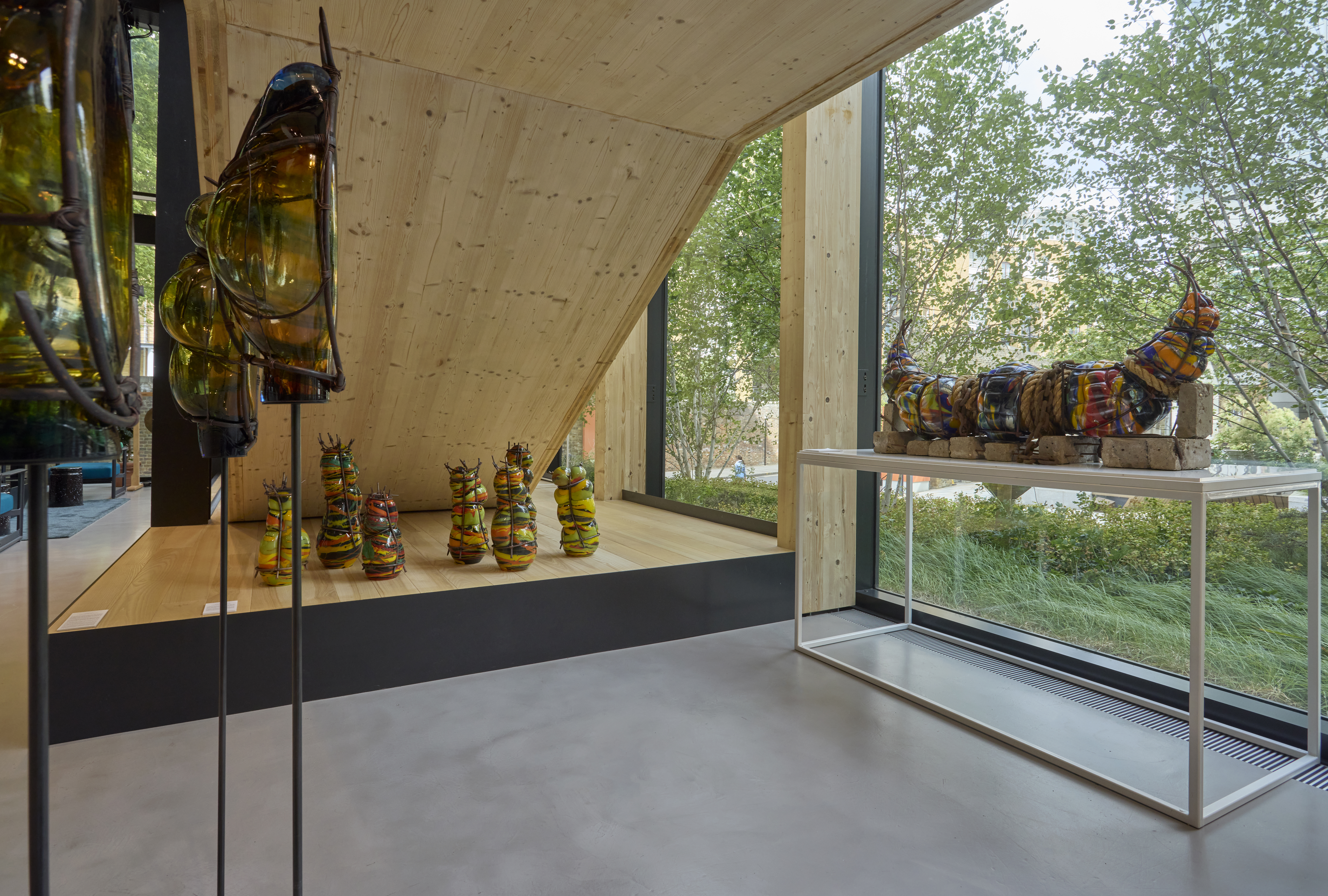

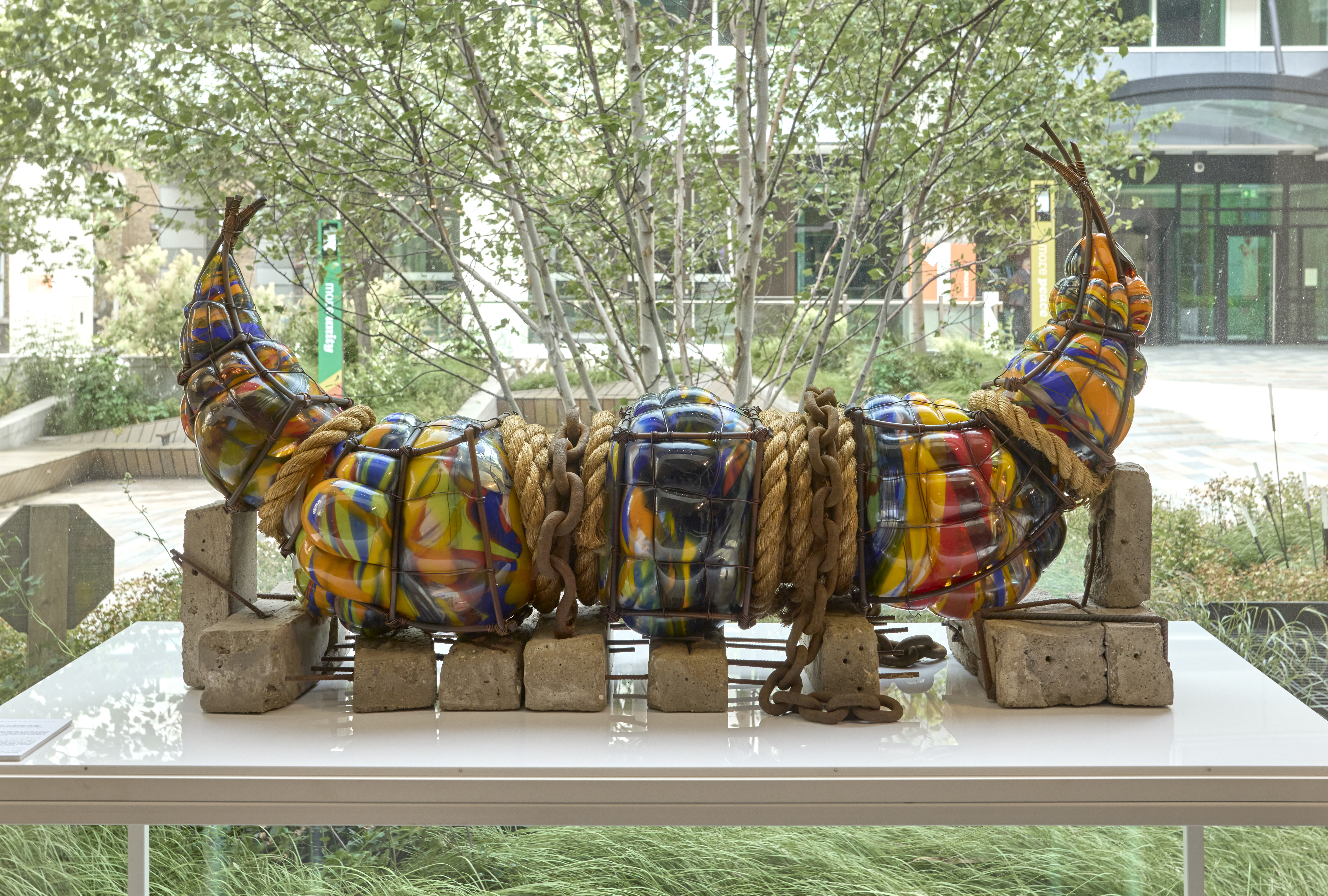
After the Darkness, the Light (Shown above)
Unique sculpture - on loan from the Stourbridge Glass Museum
Blown & sculpted glass with mixed media
This sculpture is in direct response to the war in Ukraine and questions why refugees from different conflicts receive unequal treatment; the contrasting global support for Ukrainians, in comparison to the response to those fleeing Syria, Afghanistan and Palestine.
The boat form references historical migration to Britain. Its copper structure creates tension by restricting the blown glass, whilst the vibrant colours represent the flags of nations whose people have migrated to the UK, offering a deceptive beauty that masks underlying strains. The additional materials, including concrete, rebar, chains and rope, add layered meaning, inviting viewers to engage with multiple conversations about displacement.
Day hopes the artwork prompts reflection on the disturbing images we have seen and encourages honest dialogue about immigration, both historical and present, ultimately asking us to consider our differing responses to human suffering and why that is dependent on where it originates.
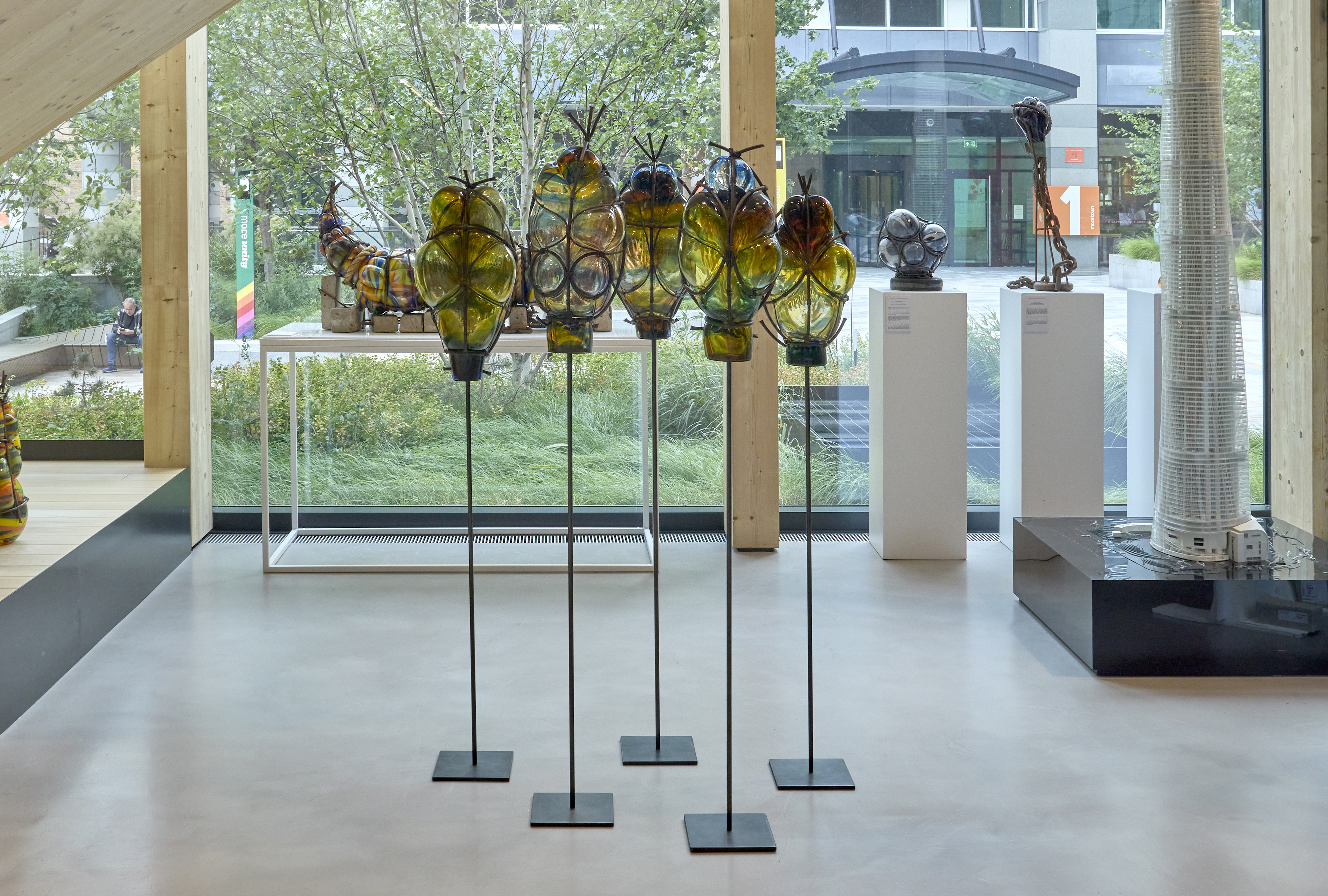
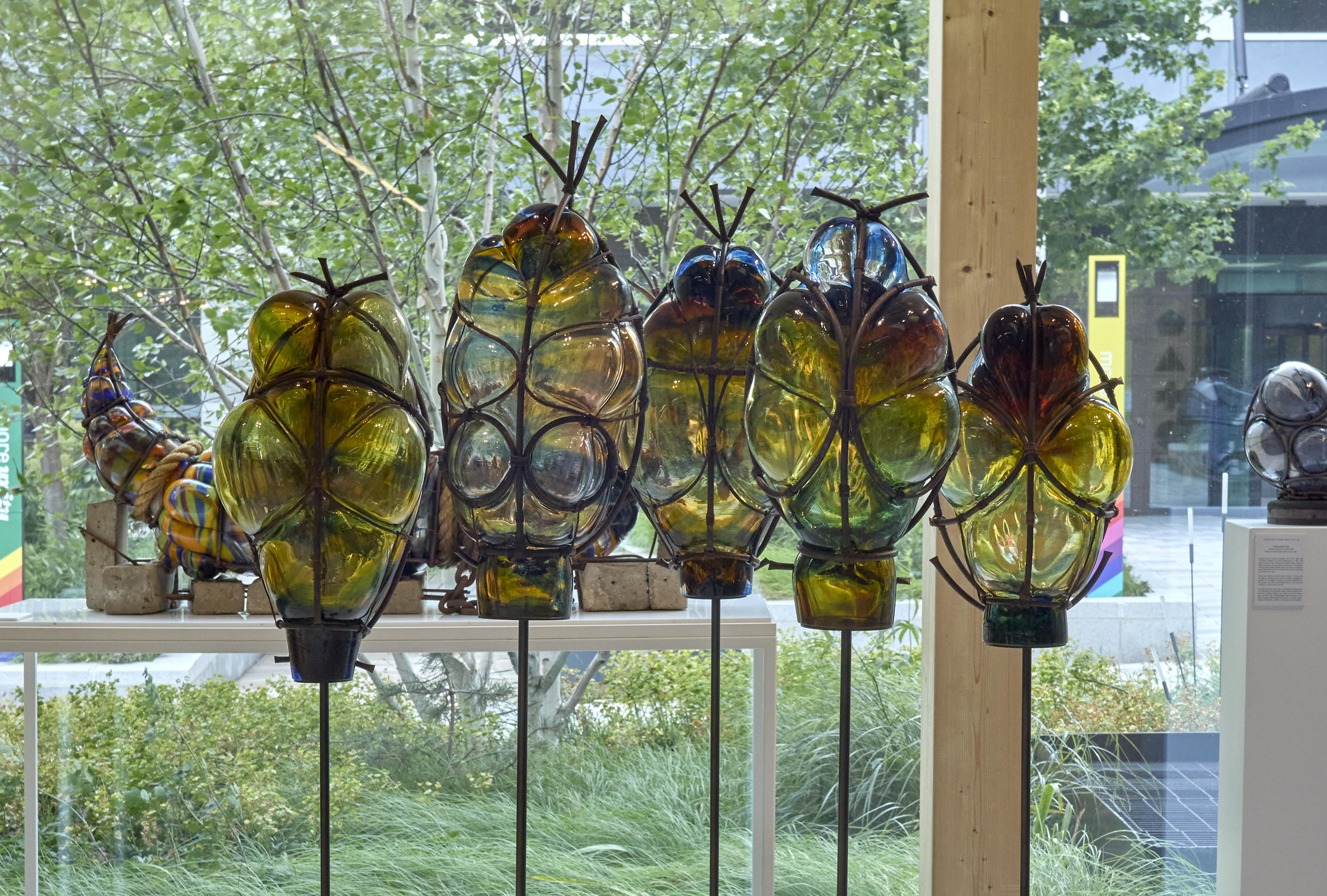
Ancestral Gaze (Shown above)
Unique installation
Blown & sculpted glass with mixed media
Standing grouped together, these five masks are inspired by depictions of the face in African art. Day focuses on the use of coloured but transparent glass, as a medium for the mask, an item which is normally intended to conceal the face behind it. The use of glass, by contrast, exposes the identity of the imagined wearer. In particular, the exaggerated proportions of the eyes draw attention to what for Day is the most interesting part of the face, "the eyes are the entry point to your soul".
In making these self-revealing masks, Day puts his African heritage on display for all to see. The risks involved in this self-exposure are symbolised by the fragility of the glass, which, as it is blown out through the wicker-like copper cage surrounding it, embodies the individual’s search for free expression against both internal and external resistances.
The tension between metal and glass also symbolises the more practical limits on Day’s creative freedom; he still works from day to day as a plumber, fitting his art in when time and funding are available.
The experience of growing up mixed race, Day says, may be ‘hard to understand’ for people who do not fall into this category. Similarly, "being black is not a matter of what shade you are, it’s a matter of what you’ve been through".
Even now, he still bears the ‘emotional scars’ of his past, "I don’t look at myself in a mirror. And I still find it hard to look into people’s eyes". Nevertheless, glass, not as a utilitarian mirror but as a material for art, has become his way of gazing both out at the past and into himself. 'Glass should be used to engage with people… I hope that my ancestors are looking down on me and thinking, "Thank you for telling our story”'.
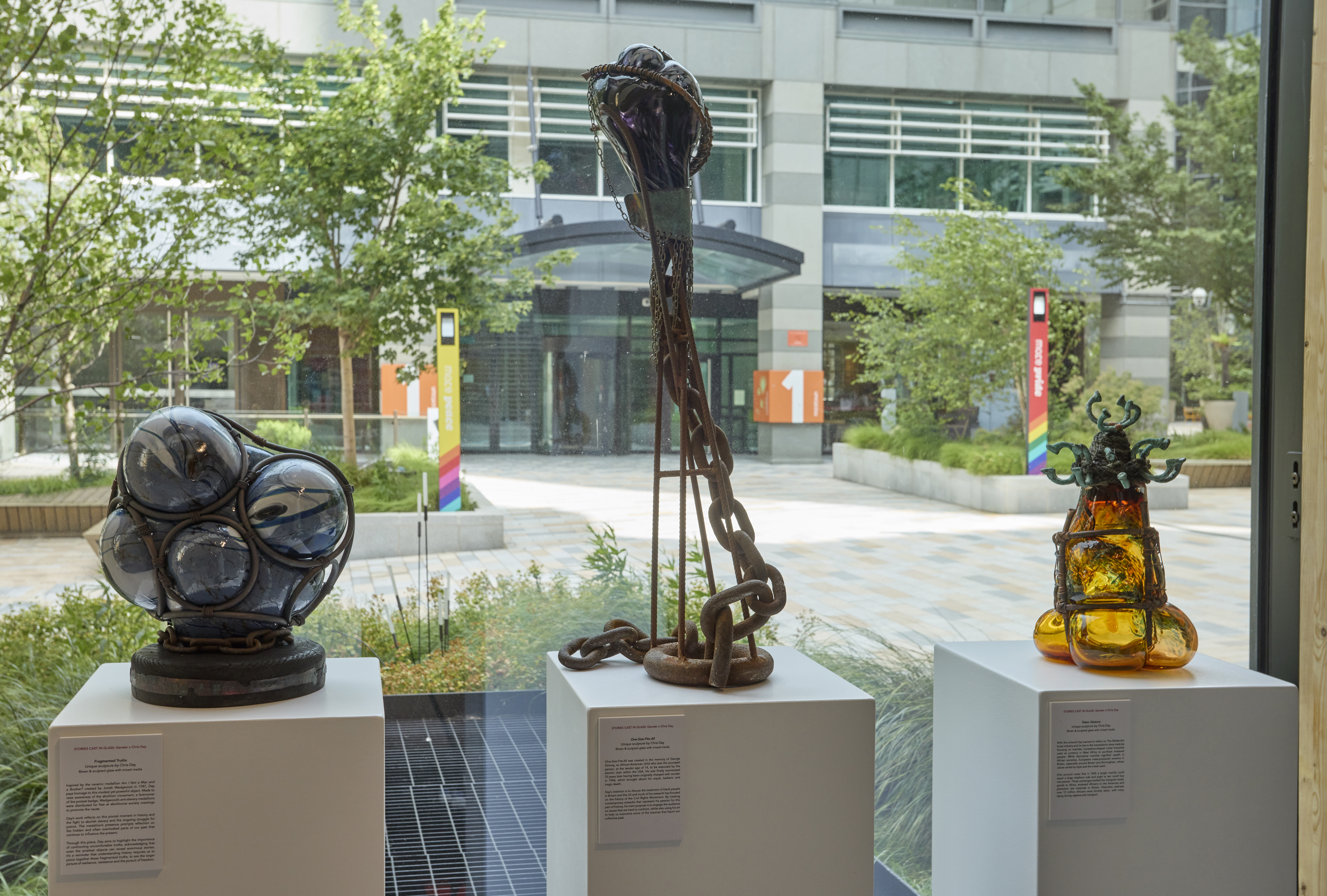
Fragmented Truths, One-Size-Fits-All and Token Gesture (Shown above)
Unique sculptures
Blown & sculpted glass with mixed media
Fragmented Truths
Inspired by the ceramic medallion Am I Not a Man and a Brother? created by Josiah Wedgwood in 1787, Day pays homage to this modest yet powerful object. Made to raise awareness of the abolition movement, a forerunner of the protest badge, Wedgwood’s anti-slavery medallions were distributed for free at abolitionist society meetings to promote the cause.
Day’s work reflects on this pivotal moment in history and the fight to abolish slavery and the ongoing struggle for justice. The medallion’s presence prompts reflection on the hidden and often overlooked parts of our past that continue to influence the present.
Through this piece, Day aims to highlight the importance of confronting uncomfortable truths, acknowledging that even the smallest objects can reveal enormous stories. It’s a reminder that understanding history requires us to piece together these fragmented truths, to see the larger picture of resilience, resistance and the pursuit of freedom.
One-Size-Fits-All
One-Size-Fits-All was created in the memory of George Stinney, an African-American child who was the youngest person, at the tender age of 14, to be executed by the electric chair within the USA. He was finally exonerated 70 years later having been originally charged with murder in 1944, which brought about his unjust, barbaric and tragic death.
Day’s intention is to discuss the treatment of black people in Britain and the US and much of his research has focused on the history of the Civil Rights Movement. By creating contemporary artworks that represent his passion for this part of history, his main purpose is to engage the audience on issues that are hard to confront, whilst also using his art to help us overcome some of the traumas that haunt our collective past.
Token Gesture
With this artwork Day wanted to reflect on The Midlands’s brass industry and its ties to the transatlantic slave trade by focusing on manillas; horseshoe-shaped metal bracelets used as currency in West Africa to purchase enslaved people. While decorative manillas signified wealth in African societies, Europeans mass-produced versions in Britain, especially around Bristol and Birmingham, where values varied by style and the metal used.
One account notes that in 1505 a single manilla could equal a large elephant tusk and eight to ten could buy one person. These exchanges fuelled the triangular trade; goods to Africa, enslaved Africans to the Americas and plantation raw materials to Britain. Historians estimate over 12 million Africans were forcibly taken, with many dying during capture and transport.
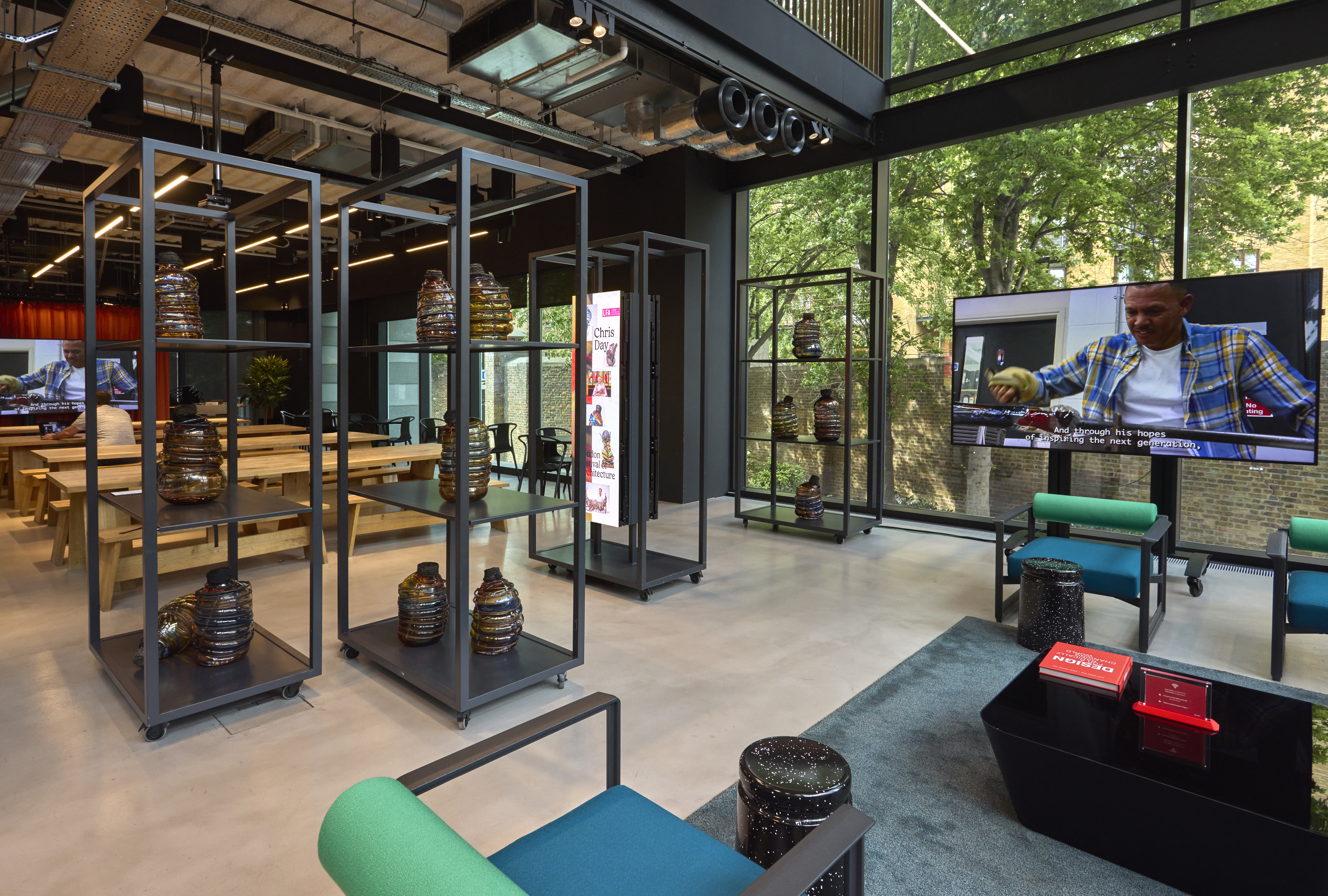
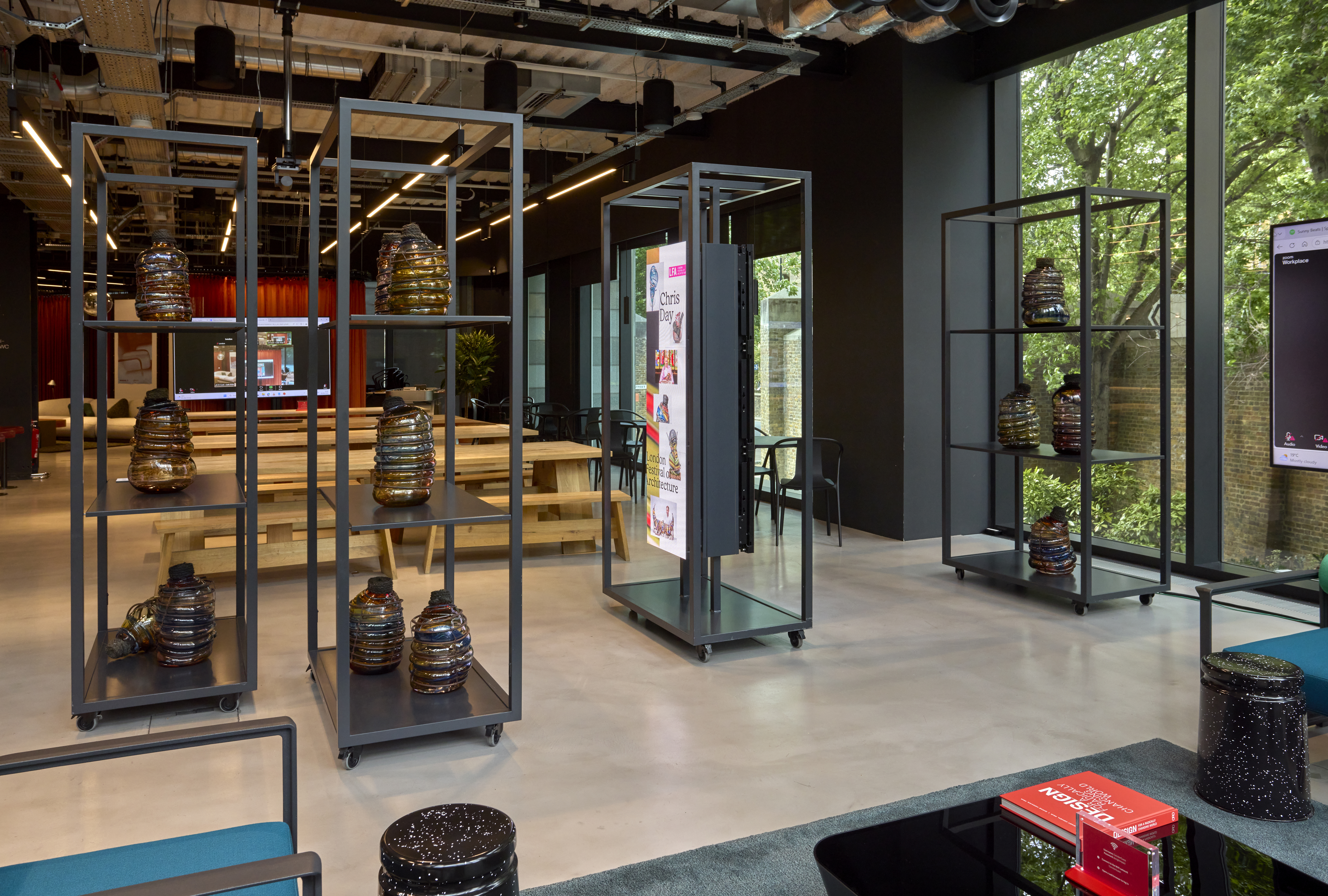
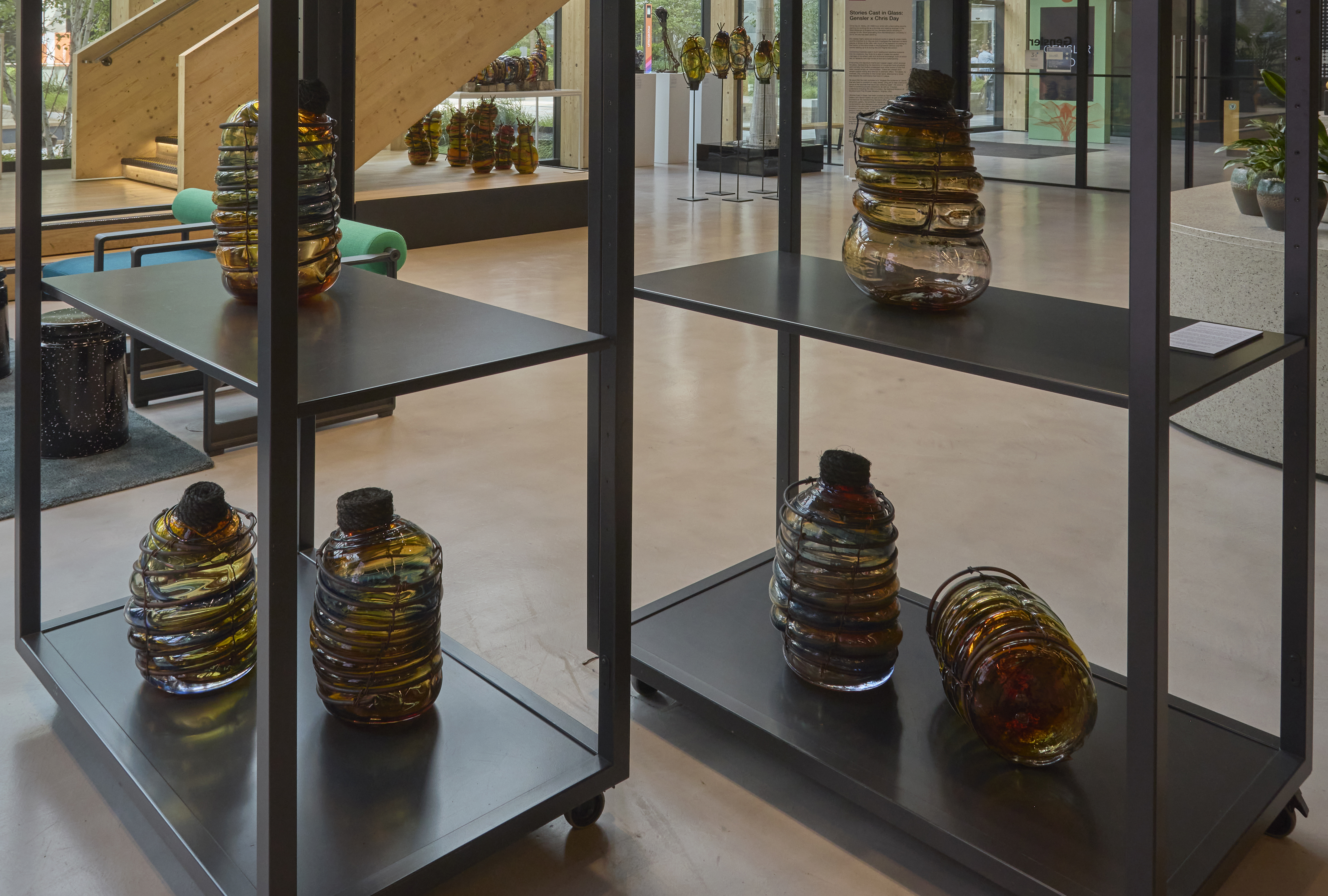
Under The Influence (Shown above)
Unique installation
Blown & sculpted glass with mixed media
Under the Influence was originally shown as a 28-piece installation at Harewood House in Leeds having been created specifically for an exhibition on colonial history during the Harewood Biennale in 2021.
The installation was conceived in response to the discovery of 28 bottles of Harewood Rum in the cellar of the main house in 2011, a spirit produced on the estate’s Caribbean sugar plantations. The bottles were auctioned in 2014 with proceeds donated to the Geraldine Connor Foundation.
Day made the bottles in colours based on Turner’s painting The Slave Ship, which is believed to illustrate the story of the transatlantic slave ship Zong, whose captain gave the order to throw 130 of his African slaves overboard in 1781, subsequently claiming financial compensation for them.
The trails of blue glass wrapped around each bottle suggest the Atlantic crossing, adding a haunting beauty. At the top of each sculpture sits a tightly wound rope cap rather than a cork, evoking the sensation of being bound, as the Africans would have been when they were shipped over to the Caribbean, to harvest sugar for rum production.
Day describes that during their making, he poured his "anger and emotion, both mentally and physically" into each heavy blown form.
The title plays on rum’s intoxicating power alongside the pervasive'influence' of slavery at the time, a system once scarcely questioned. The installation also acknowledges that slavery still persists in today’s society.

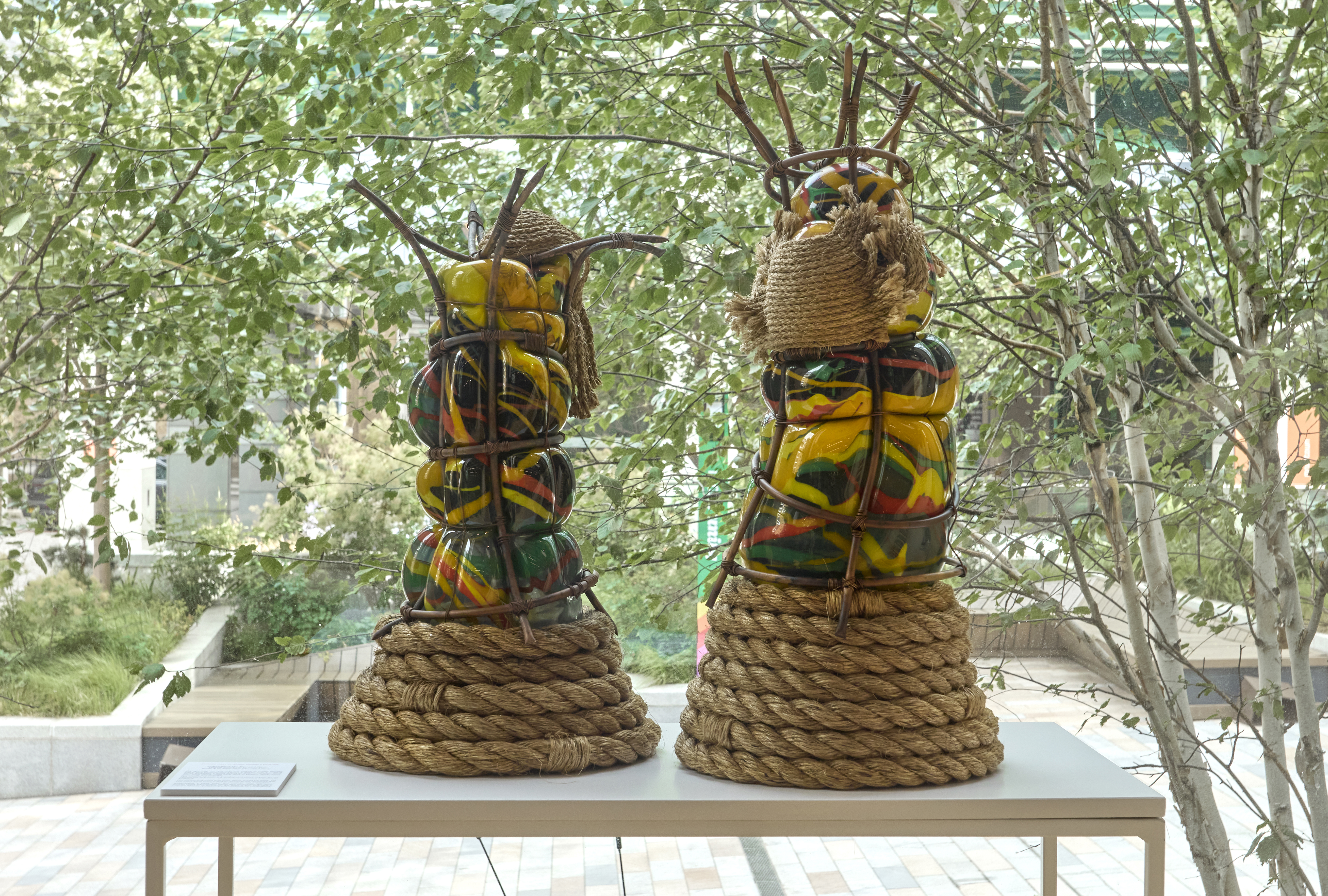
Colour-Blind The King and Queen (Shown above)
Unique sculptures
Blown & sculpted glass with mixed media
Day grew up not only with the stigma of mixed families but also with an absent father; a puzzle with a missing piece, now partially traced through DNA. His Colour-Blind series symbolise a living strand of memory. Sapele wood from West Africa, roots each work in Nigeria, symbolising genealogy and strength.
The base of each is branded with Day’s initials, an act carried out to honour his ancestors, who were branded as property. In doing so, Day aims to highlight, reject and nullify, this barbaric and torturous 'act of ownership'.
The piled jute coils forming the supportive base, alone would be weak, yet become strong once together, echoing the resilience that can come from lineage and its bonds for the individual.
Resembling a DNA helix, the copper cage references African body adornment, whilst also embracing the glass. Pushing against its guardian, the glass is also engulfed in a cloak of colour, protecting and covering its vulnerability.
ABOUT THE ARTIST
Chris Day (b. Derby, UK 1968) is an artist with a fascinating psyche. Having started his working life as a plumber and heating engineer in the West Midlands of England, after two decades he deciding to change his life. Since graduating from Wolverhampton University in 2019, his artistic rise has been startling.
Day creates highly personal sculptural works in glass & mixed media and his intention is to discuss and investigate the treatment of black people in Britain & the USA, with much of his research focussing on the history of the slave trade in the Eighteenth Century and the events leading up to & during the Civil Rights Movement.
Combining materials used in both heating and electrical systems into his creations, Day finds he is able to create the perfect marriage of his artistic path and technical knowledge, both of which rely on dexterity and high levels of skill and craftsmanship. For Day, it has not gone unnoticed, that many of the skills he has developed in his earlier career have directly transposed to the creation of his artworks, with his time at university giving him much needed artistic training and self-belief, from the support of those around him.
A recurring and signature theme are 'copper cages' which enclose his glass, representing the restriction of movement both physically and mentally that traders possessed over other human's lives that were viewed simply as 'commodities'. These are created from simple copper tubing and wire but to dramatic effect. The glass, by contrast, Day compares to the human spirit, attempting to break free despite the restrictions that hold it in place.
Day says that his main purpose is to "engage the audience on issues that are hard to confront on many levels, using art to help overcome some of the traumas that haunt our collective past". His work is held in numerous private collections, as well as 14 public collections including: the V&A in London, the National Museum of Scotland and The Chrysler Museum, Virginia, USA.
All photography by Agata Pec